RECENTLY VIEWED
Skip to main content
DK Hardware Professional Tax Exempt? Net 30? - DK Net Terms
Roll over image to zoom in
Product Features
Product Overview
Related Videos
Reviews
Questions & Answers
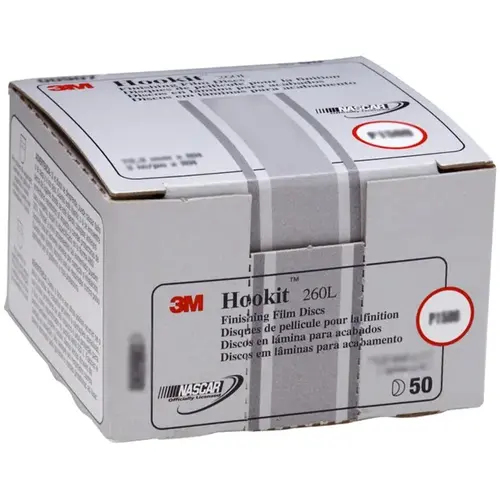
3M 953 00953 260L Series Abrasive Disc, 5 in Dia, P1000 Grit, Hook and Loop, White
Item #: 953 by 3M
UPC #: 051131009530
See reviewsSee reviews
30 Days Easy Return. We are the largest supplier of the most adaptable, personalized hardware in the industry. We work hard to ensure you're satisfied with our products.
Features
- Film backed abrasive discs provide durability for high finish auto body sanding applications
- Aluminum oxide abrasive cuts fast and long life
- Durable film backing is tear-resistant and provides a consistent finish
- Hookit™ attachment system makes for fast disc change outs and longer disc life
Grade
Super Fine
Application
For paint defect removal and repairing large area paint defects
Grit
P1000
Attachment Type
Hookit™ Hook and Loop
Abrasive Material
Aluminum Oxide
Wet/Dry
Dry
Part no.
0953
MFR Model
953
Diameter (in)
5
Vacuum (yes/no)
No
Backing Material
Film
Color/Finish
White
Series
260L
Disc Diameter
5"
Color
White
Package Quantity
100 discs per box, 4 boxes per case
Trade Name
Hookit
Alternative UPC
60650034907
Product Overview
Our 3M™ Hookit™ film disc 260L is ideal for auto body applications including blending, scuffing, paint prep and removing paint defects. Choose aluminum oxide mineral cutting surfaces from P600 to P1500, all on durable film backing. Several versions of the disc feature our five or six-hole design to help keep dust away from the disc surface. Hookit™ attachment makes it easy to change and reuse discs. Our 3M™ Hookit™ film disc 260L combines durable film backing with fast-cutting, long-lasting aluminum oxide mineral abrasive. Aluminum oxide is a popular choice among industrial professionals because of its fast cut rate and long life. This mineral makes a tough, durable abrasive that self-fractures to expose fresh cutting edges, whereas traditional natural abrasives dull more quickly. Due to its fast cut-rate, hardness and strength, it is widely used in grinding applications in addition to sanding and finishing applications. Aluminum oxide is suitable for a wide variety of materials in metalworking, including ferrous alloys.
3M Hookit coated 260L hook & loop disc uses aluminum oxide as the abrasive material and has a diameter of 5 in. 3M incorporates this aluminum oxide material into the hook & loop disc forming a grit of P1000.
Specifications:
Specification parameters description:
Abrasive Material:
Values: A/O Aluminum Oxide AO A/Z Alumina Zirconia AZ S/C Silicon Carbide SC Aluminum Oxide Aluminum oxide is an artificial abrasive suited for general purpose stock removal and finishing. It is the mostly commonly used abrasive and can be used for most steels and ferrous alloys. Aluminum oxide is slightly softer but tougher than silicon carbide. Ceramic Ceramic is used for aggressive cutting and grinding of stainless steel, titanium, and metal alloys. The abrasive grain is designed to fracture during use so that it maintains sharpness. Ceramic Aluminum Oxide Cerium Oxide Cerium oxide is used for fine polishing and lapping of glass, gemstones, optical mirrors, and lenses. It should be used wet or in slurry form. Diamond Diamond can be either natural or manufactured and is one of the hardest abrasive materials. It is commonly used for grinding and polishing stone and very hard steels, and for sharpening other cutting tools. Nylon Silicon Carbide Silicon carbide is a manufactured material that is extremely hard but brittle. It is commonly used for fast cutting under light pressure, particularly on cast iron, nonferrous metals, and materials such as glass and plastic. Precision Shaped Ceramic Grain Zirconia
Grit:
Grit is a measurement of the size of abrasive particles embedded in coated abrasives. The most common standards for grit size are the United States CAMI (Coated Abrasive Manufacturers Institute) and the European FEPA (Federation of European Producers of Abrasives). A smaller grit number means larger particles and a coarser grade, while high number grits are used for finer work. Grit is generally a unitless measure but is sometimes measured in microns.
Grade:
Grade is a measurement of the size of abrasive particles embedded in coated abrasives. It is a more general measurement of the level of precision, and corresponds roughly to grit. A smaller grit number means larger particles and a coarser grade, while high number grits are used for finer work.
3M Hookit coated 260L hook & loop disc uses aluminum oxide as the abrasive material and has a diameter of 5 in. 3M incorporates this aluminum oxide material into the hook & loop disc forming a grit of P1000.
Specifications:
Abrasive Type: Coated
Specification parameters description:
Abrasive Material:
Values: A/O Aluminum Oxide AO A/Z Alumina Zirconia AZ S/C Silicon Carbide SC Aluminum Oxide Aluminum oxide is an artificial abrasive suited for general purpose stock removal and finishing. It is the mostly commonly used abrasive and can be used for most steels and ferrous alloys. Aluminum oxide is slightly softer but tougher than silicon carbide. Ceramic Ceramic is used for aggressive cutting and grinding of stainless steel, titanium, and metal alloys. The abrasive grain is designed to fracture during use so that it maintains sharpness. Ceramic Aluminum Oxide Cerium Oxide Cerium oxide is used for fine polishing and lapping of glass, gemstones, optical mirrors, and lenses. It should be used wet or in slurry form. Diamond Diamond can be either natural or manufactured and is one of the hardest abrasive materials. It is commonly used for grinding and polishing stone and very hard steels, and for sharpening other cutting tools. Nylon Silicon Carbide Silicon carbide is a manufactured material that is extremely hard but brittle. It is commonly used for fast cutting under light pressure, particularly on cast iron, nonferrous metals, and materials such as glass and plastic. Precision Shaped Ceramic Grain Zirconia
Grit:
Grit is a measurement of the size of abrasive particles embedded in coated abrasives. The most common standards for grit size are the United States CAMI (Coated Abrasive Manufacturers Institute) and the European FEPA (Federation of European Producers of Abrasives). A smaller grit number means larger particles and a coarser grade, while high number grits are used for finer work. Grit is generally a unitless measure but is sometimes measured in microns.
Grade:
Grade is a measurement of the size of abrasive particles embedded in coated abrasives. It is a more general measurement of the level of precision, and corresponds roughly to grit. A smaller grit number means larger particles and a coarser grade, while high number grits are used for finer work.