


Thermostats are one of the most important – yet often overlooked – components of any heating and cooling system. Often treated as an afterthought, most people only think about the thermostat when something feels off. The house won’t warm up evenly. The heat keeps kicking on and off. Or the energy bill shows up, and it’s higher than expected, even though nothing has changed.
That little box on the wall controls when your heating system runs, how long it stays on, and how hard it works. If it’s outdated or not a good match for your system, it can waste energy without you realizing it. If you’re getting ready for winter, upgrading an older home, or replacing a failing unit, the thermostat you choose can make a noticeable difference.
With heating costs higher than they’ve been in years, the question isn’t just about comfort anymore.
This guide breaks down the major thermostat categories used in residential and commercial applications, from traditional mechanical controls to smart thermostats, explaining their core functionality, system compatibility, and feature differences so buyers and installers can make informed decisions and prevent installation errors or performance issues.
What Is a Thermostat and How Does It Work?
A thermostat is a regulating device component which senses the temperature of a physical system and performs actions so that the system’s temperature is maintained near a desired setpoint.
At its core, every thermostat performs three essential functions:
- Sensing temperature through an internal or remote sensor
- Comparing that temperature to your set point
- Activating HVAC equipment to maintain comfort
Modern thermostats go far beyond simple on/off control. Many now optimize run times, learn usage patterns, and help reduce energy consumption – especially important as energy costs continue to rise across the U.S.
Types of Thermostats
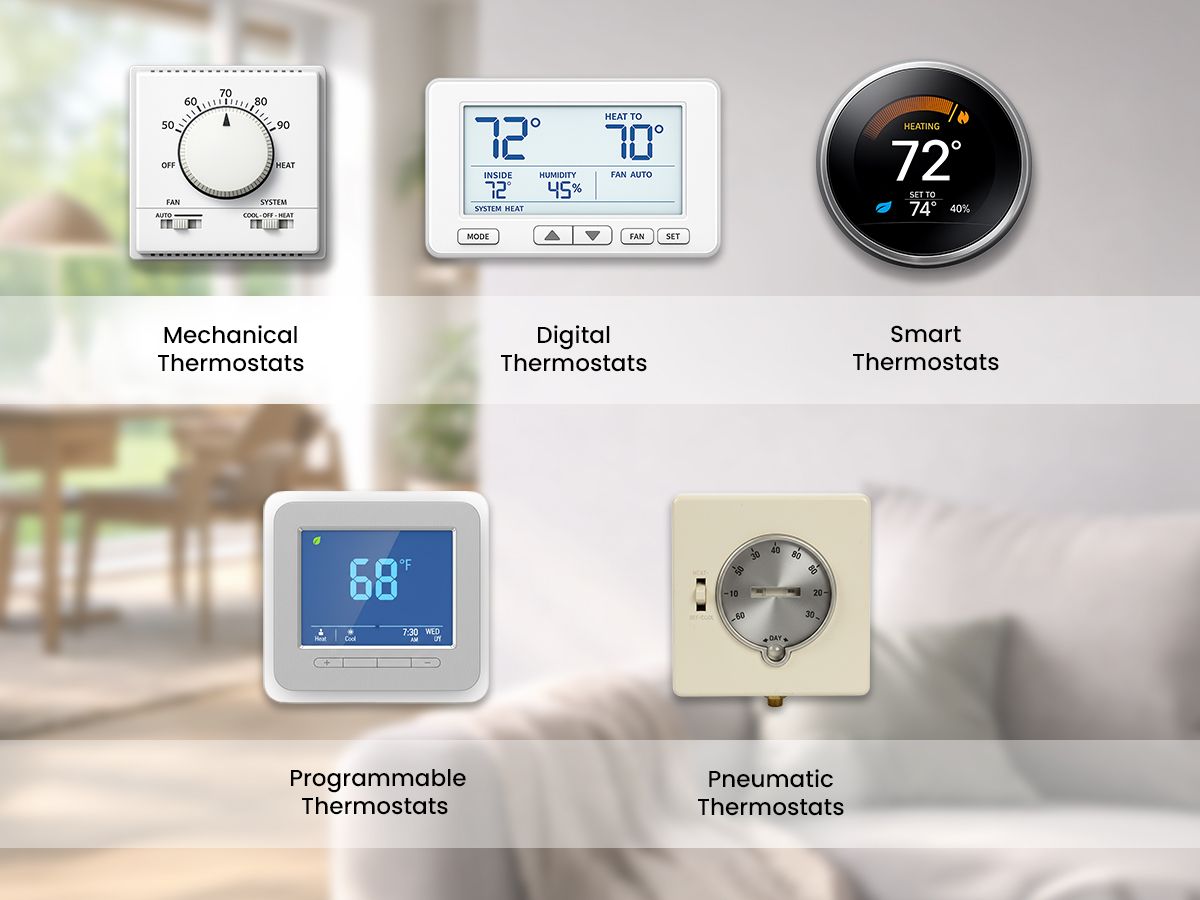
Thermostats are not one-size-fits-all, and there is an assortment of thermostats that have different features and perform in different ways. Let’s explore the most common types of thermostats:

1. Mechanical Thermostats
Mechanical thermostats, also called manual thermostats, are very basic. They are often found in older homes. As the name suggests, you must set the temperature by hand, usually by turning a dial. Mechanical thermostats contain heat-sensitive metallic strips that respond to temperature variations. However, they are somewhat outdated because of their unreliable performance.
If you need help hooking up this thermostat, one of our technicians would be glad to install it for you.
Pros
- Inexpensive.
- Mechanical thermostats are very simple, so malfunctions are easy to diagnose.
- Easy to use.
- Long lifetime.
Cons
- Slow reaction to temperature changes.
- Minimal temperature control selections.
- Not programmable.
- Outdated.
The cost of these thermostats ranges from $15-50 for the unit, $50-150 for installation.
💡
Tip: Use mechanical thermostats for rental properties where tenants control temperatures, vacation homes with minimal use, or situations requiring the absolute cheapest replacement.
2. Digital Thermostats
Digital thermostats use electronic sensors instead of metal coils, giving precise digital readouts and pushbutton controls. But like mechanical models, they require constant manual adjustment every time you want a different temperature.
Pros
- Digital sensors read temperature more precisely, making them more accurate than a mechanical thermostat, which helps maintain steadier comfort.
- Clear, easy-to-read display so no more guessing where the dial is! The temperature is shown clearly on the screen.
- A low-cost step up from mechanical thermostats without paying for features you won’t use.
- Reliable and low maintenance with fewer moving parts than mechanical models and no software to update.
Cons
- No automatic energy savings. You must remember to adjust the temperature every time you leave, sleep, or return.
- Still requires manual effort. If you forget to turn it down before work, it heats all day just like a mechanical thermostat.
- It has limited features, so no scheduling, remote access, or energy reports.
- Easy to misuse during winter. On cold mornings, it’s common to leave it higher than needed and forget to lower it later.
Think of them as mechanical thermostats that went digital but stopped there. You get better accuracy and a more transparent display, but you’re still walking to the wall to change settings.
3. Programmable Thermostats
Here’s where energy savings start getting real. Programmable thermostats let you pre-program different temperatures for different times of day and days of the week.
Cost: $80-160 for the unit, $100-400 total installed
Pros
- Real, measurable energy savings. Lowering the temperature by 7–10°F for 8 hours per day can cut heating costs by about 10%.
- Once programmed, the thermostat automatically adjusts without daily input.
- Good payback period. With average winter heating costs near $976, many homes recover the cost in 1–2 seasons.
- Mainly, you don’t require the internet. It is a reliable operation without Wi-Fi or apps.
Cons
- The interfaces can be frustrating. Small buttons, layered menus, and unclear instructions discourage setup.
- If your schedule varies, you may constantly override the program.
- It won’t adapt to holidays, sick days, or unexpected changes on its own.
Bottom line, this works great if your schedule is predictable. Program it to lower temperatures when you’re at work, and have it warm the house before you return. Problems arise when your schedule varies – then you’re constantly overriding the program, and many people just give up.
4. Smart Thermostats
Smart thermostats are the dominant category in 2026, and can be controlled by voice commands, provide energy usage reports, and even alert you when you need to change your HVAC’s filter and when to schedule HVAC maintenance. Others are even smart enough to know when you’re coming home and will make the house comfy when you arrive!
Pros
- Improves energy efficiency.
- Compatible with other smart devices.
- Have a variety of climate controls.
Cons
- The most expensive thermostat.
- You need to be tech-savvy to use them.
- They can be hacked.
What makes them “smart”:
- Wi-Fi connectivity for remote control via smartphone
- Learning capabilities that adapt to your patterns
- Geofencing (adjusts based on your phone’s location)
- Detailed energy usage reports
- Voice control (Alexa, Google Assistant, Siri)
- Remote sensors for balancing multi-room temperatures
- Weather-responsive adjustments
Top models in 2026:
*Nest requires a C-wire for heating-only, cooling-only, or zone-controlled systems
PS, you can find all these listed thermostats at DK Hardware.
5. Pneumatic Thermostats
Pneumatic thermostats use compressed air (15-20 PSI) instead of electricity to control HVAC systems. A bimetallic element responds to temperature changes by opening or closing air passages, which changes the air pressure sent through tubing to actuators.
Cost: $150-400 per unit. Primary use: Commercial buildings, schools, hospitals, and office buildings built before 2000
Pros
- Pneumatic systems are known to operate for decades with minimal failure, making them highly durable and reliable.
- No electrical power required at the thermostat. So useful in older buildings where the electrical infrastructure is limited.
- Well-suited for multi-zone commercial HVAC systems.
- Low risk of total system failure. Simple mechanical operation makes it dependable in critical environments like hospitals.
Cons
- No programming or automation. Temperature changes must be made manually at each thermostat.
- No remote access or monitoring. Facility managers can’t see or adjust settings without being on-site.
- Very expensive to fully replace. Converting to a digital system often requires opening walls, removing tubing, and running new wiring—costs can reach $2,000–$3,000 per zone.
- They don’t support scheduling, demand response, or energy optimization.
💡
Tip: If you own a commercial building, you’ll never interact with these. Residential HVAC uses electric or electronic controls exclusively.
6. Appliance Thermostats
Appliance thermostats control temperature in specific equipment, not whole-home HVAC systems.
Cost: $15-100 depending on application
Common applications:
- Water heaters
- Refrigerators and freezers
- Baseboard heaters (individual room electric heating)
- Attic fans (temperature-based ventilation)
- Greenhouse heaters
Winter relevance: If you heat with electric baseboards, each room typically has its own line-voltage thermostat mounted on the wall. You can find programmable and smart versions explicitly designed for baseboard heaters.
💡
Important: Don’t confuse them with the HVAC thermostats. An HVAC thermostat won’t work on a baseboard heater, and a line-voltage appliance thermostat shouldn’t be wired into a furnace system.
Thermostat Accessories You Must Have
When it comes to HVAC systems, comfort and efficiency go beyond just controlling the temperature. Accessories like humidistats and thermostat guards play essential roles in ensuring optimal indoor conditions and system protection.
Humidistats:
- Humidistats control indoor moisture levels by regulating whole-house humidifiers or dehumidifiers.
- They prevent excessively dry air during winter, which can make homes feel colder and uncomfortable.
- Using humidistats, help maintain indoor humidity levels around 30–40%, improving comfort without adjusting thermostat settings.
- They are primarily used in homes with forced-air heating and whole-house humidification systems.
Thermostat Guards & Cover Plates:
- It protects thermostats from accidental or unwanted temperature adjustments.
- You can find it commonly in schools, offices, rental properties, and healthcare settings where consistent temperature control is crucial.
- Using thermostat guards & cover plates helps limit adjustments in residential settings, especially by children, guests, or tenants.
- Additionally, cover plates hide wall marks when replacing older thermostats.
These accessories usually complement thermostats simply by addressing comfort control issues and preventing misuse. These offer a practical solution to common HVAC challenges.
Which Thermostat Is Right for You?
Before diving into technical details, here’s a quick guide to match your situation with the right thermostat:
| Situation | Best Thermostat Type | Why |
| Heating bill over $1,000/winter, irregular schedule | Smart thermostat | Highest savings potential, adapts to changing routines |
| Predictable 9-5 schedule, moderate heating costs | Programmable | Good savings without a premium price |
| Home most of the day, small space | Mechanical or digital non-programmable | Simple and inexpensive |
| Frequent traveller, want remote control | Smart with geofencing | Adjust from anywhere, automatic away mode |
| Multi-story home with hot/cold spots | Smart with remote sensors | Balances temperatures across floors |
How to Find the Right Thermostat Placement?
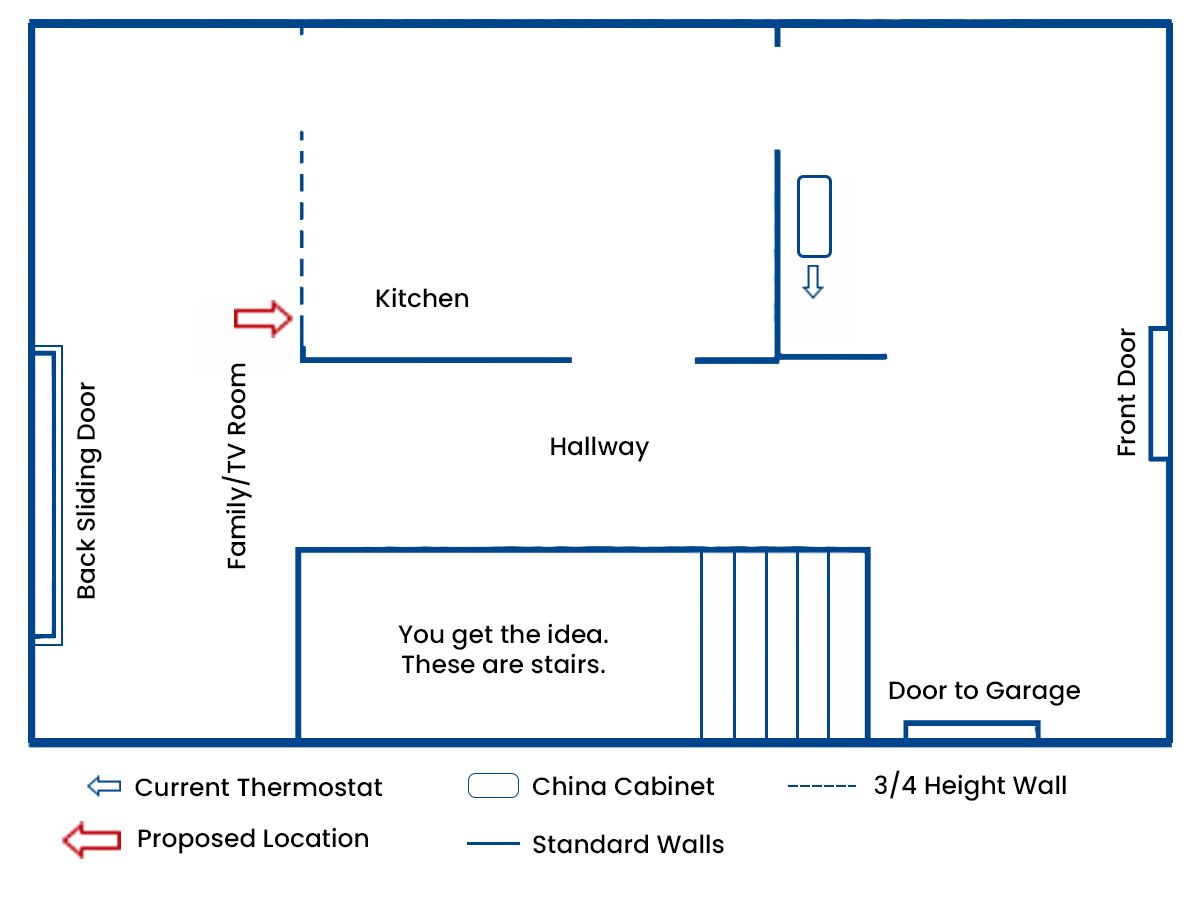
A correct placement is critical for thermostat accuracy.
Best Thermostat Placement Guidelines
- Interior wall
- Approximately 52–60 inches above the floor
- Central living area
- Away from sunlight, drafts, vents, and heat sources
Poor placement can cause short-cycling, uneven temperatures, and increased energy use.
Common Thermostat Mistakes That Increase Energy Bills
- Setting extreme temperatures, expecting faster heating or cooling
- Ignoring scheduling features
- Placing thermostats near windows or appliances
- Constant manual overrides on programmable or smart thermostats
- Blocking airflow around the thermostat
How to Check If a Thermostat Is Working Properly
Here are a few signs to tell if a thermostat is functioning correctly, look of for these:
- The HVAC system responds when the temperature is changed
- The display shows accurate readings
- System cycles on and off appropriately
If problems persist after checking power and batteries, a professional inspection may be required.
How to Replace a Thermostat Safely?
Replacing a thermostat is very simple. Follow these basic replacement steps:
- Turn off the HVAC power at the breaker
- Label existing wires
- Remove the old thermostat
- Install the new thermostat according to the manufacturer’s instructions
- Restore power and test the system
Complex systems or smart thermostat installations may require professional assistance.
FAQs about Thermostats
- How long do thermostats typically last?
Mechanical thermostats can last 20-30 years. Digital programmable models typically last 10-15 years. Smart thermostats have shorter effective lifespans (5-10 years) due to software obsolescence and Wi-Fi standard changes, though basic heating/cooling functions usually continue working after software support ends.
2. Can I install any thermostat with any HVAC system?
No, you can’t. Majorly, compatibility depends on your system type (forced air, heat pump, radiant, multi-stage), voltage (24V low-voltage vs. 120V/240V line voltage), number of wires, and specific features. Always use manufacturer compatibility checkers before purchasing.
3. Do I really need a C-wire for a smart thermostat?
It depends on the model and your HVAC system. Some models absolutely require it (Ecobee, most Honeywell innovative models). Others work without it, using power-stealing technology like Nest or have batteries, for example, the Sensi.
4. Should I upgrade my thermostat or my HVAC system first?
If your HVAC system is 15+ years old, breaks down frequently, or is dramatically oversized/undersized for your home, replace it first. A new thermostat can’t fix an inefficient or failing heating system.
5. What’s the difference between Nest and Ecobee?
Nest Learning Thermostat automatically creates schedules by observing your manual adjustments over 1-2 weeks. Ecobee requires more manual programming but includes remote sensors (Nest sensors sold separately) and has Alexa built into the Premium model. Both deliver similar energy savings. Choose based on preference automatic learning (Nest) versus included sensors and voice assistant (Ecobee).
6. Do programmable thermostats really save energy if most people don’t program them?
Studies show 40-70% of programmable thermostat owners never use the programming features. In those cases, no, they don’t save energy compared to a manual thermostat. This is why smart thermostats with learning capabilities and automatic geofencing have become popular – they reduce energy without requiring user programming.
7. Can I control multiple zones with one thermostat?
No, you can’t control multiple zones with a standard single-zone system. You’ll either need multiple separate thermostats (one for each zone) with zone dampers in your ductwork, or a multi-zone control panel that communicates with multiple thermostats or zone controllers.
Conclusion
Thermostats are not just comfort controls – it manages your energy footprint. Finding the right balance between manual, programmable, or smart technology depends entirely on how you use it in your space.
While a new thermostat is a great first step toward lower energy bills, it works best when the rest of your home is sealed and insulated. Think of the thermostat as the finishing touch on a healthy home system. At DK Hardware, you will find a wide range of thermostats and accessories, and replacement parts from trusted brands, along with clear product information and fast nationwide shipping and bulk purchasing discounts. Having the right hardware makes the decision easier and the installation smoother.