


How Many UL 752 Levels Are There?
The 11th edition, which most catalogs and drawings still use, has ten numbered ballistic glass levels plus two extra shotgun tests. Each test round has to hit inside a set speed window, from the minimum up to 110% of it, which is why every velocity in the UL 752 chart below is a range.UL 752 Chart of Test Rounds, Speeds and Shot Counts
| Level | Test Round | Bullet Weight (gr) | Shots | Velocity, ft/s (m/s) | Where It’s Usually Specified |
| 1 | 9 mm full metal jacket | 124 | 3 | 1,175–1,293 (358–394) | Gas stations, convenience stores, pharmacies, ticket booths |
| 2 | .357 Magnum jacketed soft point | 158 | 3 | 1,250–1,375 (381–419) | Check cashing, dispensaries, hotel night windows |
| 3 | .44 Magnum lead semi-wadcutter | 240 | 3 | 1,350–1,485 (411–453) | Banks, jewelers, police lobbies, safe rooms |
| 4 | .30-06 rifle, lead core soft point | 180 | 1 | 2,540–2,794 (774–852) | Courthouses, government offices, guard booths |
| 5 | 7.62 mm military ball (.308) | 150 | 1 | 2,750–3,025 (838–922) | Corporate lobbies, utilities |
| 6 | 9 mm full metal jacket | 124 | 5 | 1,400–1,540 (427–469) | Rarely specified for buildings |
| 7 | 5.56 mm full metal jacket (.223) | 55 | 5 | 3,080–3,383 (939–1,031) | School entries, embassies |
| 8 | 7.62 mm military ball (.308) | 150 | 5 | 2,750–3,025 (838–922) | Embassies, federal facilities |
| 9 | .30-06 armor piercing | 166 | 1 | 2,715–2,987 (828–910) | Armories, military sites |
| 10 | .50 caliber military ball | 709.5 | 1 | 2,810–3,091 (856–942) | Military and defense sites |
| Shotgun, slug | 12 gauge rifled lead slug | 437 | 3 | 1,585–1,744 (483–532) | Specified only with a documented shotgun threat |
| Shotgun, buckshot | 12 gauge 00 buckshot | 650 | 3 | 1,200–1,320 (366–402) | Specified only with a documented shotgun threat |
The Handgun Tiers (Levels 1 to 3)
Most robberies involve a handgun, so most bullet resistant counters get specified somewhere between Level 1 and Level 3.- UL 752 Level 1: Three shots from a 9 mm handgun. Level 1 bullet resistant glass is the usual starting point for gas station, convenience store and pharmacy counters. Most stock bullet resistant transaction windows ship at Level 1, with Level 3 glazing offered on select models.
- UL 752 Level 2: Three shots from a .357 Magnum, which hits harder than a 9 mm. You’ll see it at check-cashing counters, dispensaries and hotel night windows.
- UL 752 Level 3: Three shots from a .44 Magnum, a 240-grain bullet moving at up to 1,485 ft/s (453 m/s). Level 3 bullet resistant glass is where banks, jewelers and police lobbies usually end up.
The Rifle and Rapid-Fire Tiers (Levels 4 to 8)
Rifle rounds move about twice as fast as the handgun rounds above, and the plastics that stop handguns won’t stop them.- UL 752 Level 4: One shot from a .30-06, the classic deer-hunting rifle, firing a 180-grain soft point at 2,540 ft/s (774 m/s) or faster. That’s about 2,580 ft-lb (3,500 J), compared with about 970 ft-lb (1,320 J) for the .44 Magnum at Level 3. This is where acrylic and solid polycarbonate drop out. Polycarbonate tops out at Level 3, so Level 4 bullet resistant glass means glass-clad polycarbonate, which roughly doubles the weight per square foot of a Level 3 polycarbonate sheet. Courthouses, government offices and guard booths are the usual Level 4 jobs.
- UL 752 Level 5: One 7.62 mm military ball round, the 7.62×51 NATO cartridge that’s close to a .308 Winchester. “Ball” means a full metal jacket bullet that holds its shape instead of mushrooming like the Level 4 soft point. The bullet is lighter than Level 4’s (150 grains vs. 180) but faster, at 2,750 ft/s (838 m/s) or more, so the energy lands in about the same place, roughly 2,520 ft-lb (3,420 J). Corporate lobbies and utility sites use Level 5 when the threat assessment names a military-style rifle instead of a hunting rifle.
- UL 752 Level 6: Five shots from a 9 mm with the same 124-grain bullet as Level 1. The difference is speed and shot count. Level 6 rounds travel at 1,400 ft/s (427 m/s) or faster, versus 1,175 ft/s at Level 1, which is the kind of speed a 9 mm picks up from a submachine gun’s longer barrel. It’s still a handgun cartridge at about 540 ft-lb (730 J) per shot, far below any rifle round in this tier, and building specs rarely call for it.
- UL 752 Level 7: Five shots from a 5.56 mm (.223) rifle, the round an AR-15 fires. The bullet is tiny at 55 grains, but it’s the fastest in the whole standard at 3,080 ft/s (939 m/s) or more. Each hit carries about 1,160 ft-lb (1,570 J), less than half a .30-06, but the glass has to take five of them. Glass-clad polycarbonate at this level usually runs 1-15/16 to 2-1/2 in. (49 to 64 mm) thick and 22 to 26 lb per sq ft, and school entries and embassies are where you’ll see it specified.
- UL 752 Level 8: Five 7.62 mm military ball rounds, the same bullet and speed as Level 5. The only change is the shot count, and that alone takes the glass in the thickness table below from 1.28 in. (33 mm) at Level 5 to 2.07 in. (53 mm) at Level 8, and about 55% more weight per square foot. Level 8 bullet resistant glass is the toughest rating most building specs ever call for, usually at embassies and federal facilities.
- When you’re choosing between these levels, the shot count matters as much as the cartridge. A Level 5 lite proved it can stop one .308-class round. Nobody tested it for a second hit in the same pane.
The Heavy Military Tiers (Levels 9 and 10)
- Level 9: One .30-06 armor-piercing round, a 166-grain bullet with a hardened steel core, at 2,715 ft/s (828 m/s) or more. Its energy, about 2,720 ft-lb (3,690 J), is close to Level 4’s. The difference is the core. A soft point flattens when it hits, while a hardened steel core is made to keep its shape and punch through hard material like steel plate, so a barrier that stops the Level 4 round can still fail at Level 9. Armories and military sites are where Level 9 gets specified.
- Level 10: One .50 caliber military ball round (.50 BMG), the cartridge fired by heavy machine guns and long-range anti-materiel rifles. The bullet weighs 709.5 grains, almost four times the Level 4 bullet, and it hits with about 12,440 ft-lb (16,870 J), close to five times the energy. You’ll find Level 10 bullet resistant glass at armories and defense sites, and almost never on a commercial building.
What Does a UL 752 Bullet Resistant Test Look For?
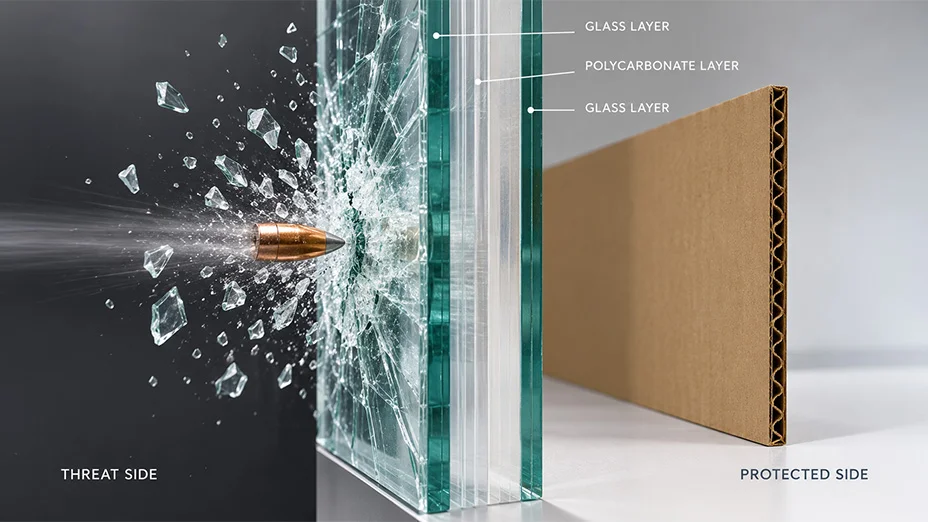
A sample passes when the bullet doesn’t get through and nothing flies off the back face hard enough to hurt whoever’s standing behind it. Under the 11th edition, the lab checks two things:- No penetration: The round can’t pass through the sample. Every round is fired from 15 ft (4.6 m).
- No spall: Spall is the spray of glass chips a hit can knock off the back face. The lab sets a corrugated cardboard indicator 18 in. (457 mm) behind the sample, and if any fragment sticks in it or damages it, the sample fails.

Which UL 752 Edition Are You Looking At?
Before you compare UL 752 bullet resistant glass quotes, check which edition of the UL 752 ballistic standards your project documents name.- UL 752 11th Edition: Numbered Levels 1 through 10. Most commercial catalogs, architectural drawings and supplier submittals still use it.
- UL 752 12th Edition (published October 2023): Swaps the numbers for 16 designations: four for handguns (UL-HG-A to UL-HG-D), ten for rifles (UL-RF-A to UL-RF-J) and two for shotguns (UL-SG-A and UL-SG-B).
How Do Thickness and Weight Vary by Product?
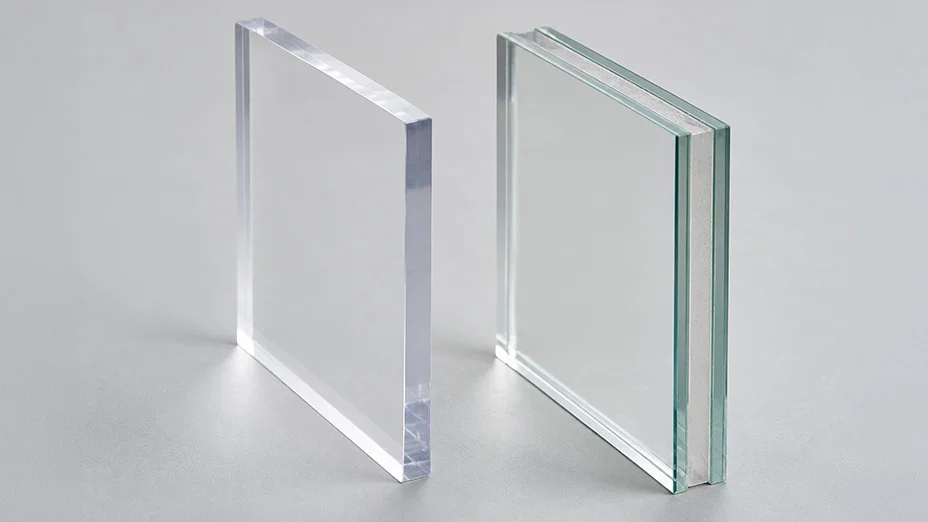
A UL 752 rating measures performance, not dimensions, so thickness and weight come down to how each fabricator builds the lite.- Acrylic and polycarbonate: Solid plastics used at Levels 1 to 3 to keep units light.
- Glass-clad polycarbonate (GCP): Polycarbonate bonded between glass layers. Fabricators use it at the higher levels, and it’s a lot heavier.
| Level | Material | Thickness | Weight, lb/sq ft (kg/m²) |
| 1 | Polycarbonate | 0.75 in. (19 mm) | 4.6 (22) |
| 1 | Glass-clad polycarbonate | 0.86 in. (22 mm) | 9 (44) |
| 3 | Polycarbonate | 1.25 in. (32 mm) | 7.7 (38) |
| 3 | Glass-clad polycarbonate | 0.98 in. (25 mm) | 11.3 (55) |
| 4 | Glass-clad polycarbonate | 1.22 in. (31 mm) | 14.5 (71) |
| 5 | Glass-clad polycarbonate | 1.28 in. (33 mm) | 14.4 (70) |
| 8 | Glass-clad polycarbonate | 2.07 in. (53 mm) | 22.3 (109) |
What Is the Main Difference Between UL 752 and NIJ Standards?
UL 752 tests parts of a building, while NIJ tests armor that people wear or carry.- UL 752: Windows, doors, transaction counters and wall panels.
- NIJ: Vests, helmets and handheld shields. For body armor, the current NIJ 0101.07 standard uses HG1 and HG2 for handguns and RF1 to RF3 for rifles. Older armor still carries the 0101.06 labels IIA, II, IIIA, III and IV.
How Do You Choose the Right UL 752 Level for a Counter or Window?
Work through these four steps before you place an order:- Match the level to the threat you can document. Handgun threats point to Levels 1 to 3. Rifle levels need a written reason, because they add weight, frame work and cost.
- Don’t accept “low-spall” as a spec. A product either passes with no fragments reaching the indicator, or it fails at that level.
- Keep every piece at the same level. The frame, deal tray and speak-thru have to match the glass. The transaction window buying guide walks through the tray, speak-thru and night-window choices that decide whether staff can actually work behind the barrier.
- Get the test paperwork before you approve the submittal. The next section covers what to look for.
How Do You Read a UL 752 Bullet Resistant Listing?
A listing or test report proves that one specific assembly passed one specific test. Check it for five details:- The complete assembly covered: glazing, framing, anchors and hardware
- The test round, bullet weight and velocity
- The edition used, 11th or 12th
- The lab name, report number and test date
- The manufacturer and, for UL-certified products, the active UL file number
What to Do Next?
- Measure each opening’s rough width and height to the nearest 1/8 in. (3 mm), plus the wall or counter thickness, before you call a fabricator. Size drives both thickness and weight.
- Get the threat assessment in writing and assign a level or designation to every opening.
- Print the UL 752 chart above, keep it with the submittal, and check each opening’s test round against it.
- Plan a structural review for any unit getting close to rifle-level weight, using the per-square-foot figures in the thickness table.
- Bring in a professional installer for any opening in masonry or steel stud walls, or anywhere the wall has to be beefed up to carry the load.
FAQs About UL 752 Bullet Resistant Levels
No. Security film (4 to 14 mil) holds broken glass together during a smash-and-grab, but no bullet resistant window film carries a UL 752 rating on ordinary glass. If you’re worried about break-ins rather than gunfire, film or laminated security glass plus better locks is the right-sized fix.
Only if that plate was tested as part of a UL 752 assembly. Mild structural steel and heat-treated armor plate can be the same thickness and act nothing alike under rifle fire. The mill certificate tells you the grade and hardness, but only a ballistic test of that plate thickness tells you what it’ll stop.
Most UL 752 ballistic glass runs from about 3/4 in. (19 mm) for Level 1 polycarbonate to just over 2 in. (53 mm) for Level 8 glass-clad polycarbonate. Thickness won’t tell you the level on its own, though. In the table above, a 0.98 in. GCP lite and a 1.25 in. polycarbonate sheets both carry Level 3.
No code requires it, and UL itself says compliance with UL 752 is voluntary. The requirement usually comes from the owner, the insurer or the project spec. Products can be certified by UL Solutions or tested to UL 752 by another lab such as Intertek, so ask which one before you compare quotes.