RECENTLY VIEWED
Skip to main content
DK Hardware Professional Tax Exempt? Net 30? - DK Net Terms
Roll over image to zoom in
Product Features
Product Overview
Related Videos
Reviews
Questions & Answers
See reviewsSee reviews
30 Days Easy Return. We are the largest supplier of the most adaptable, personalized hardware in the industry. We work hard to ensure you're satisfied with our products.
Features
Power Source
Battery
Output Wattage
25 to 60 W
Trade Name
Pyropen
Maximum Tip Temperature
+932 °F
Handpiece Type
Iron
Operating Time
180 Minutes
Application
Soldering
Type
Pencil
Minimum Operating Temperature
200.0C
Equivalent Wattage
25 - 60
Maximum Temperature C
500.00
Maximum Temperature (F) ( - 0 Decimals)
932
Minimum Temperature (C - 2 Decimals)
200.0
Minimum Temperature (Deg F - 3 Decimals)
392
Tip Number
WPT2, WHC51
UNSPSC Code
23271603
Vendor Drop Ship
N
Operating Time Hours
180 min
Temperature Range (F)
392 - 932
Self Igniting
No
Product Overview
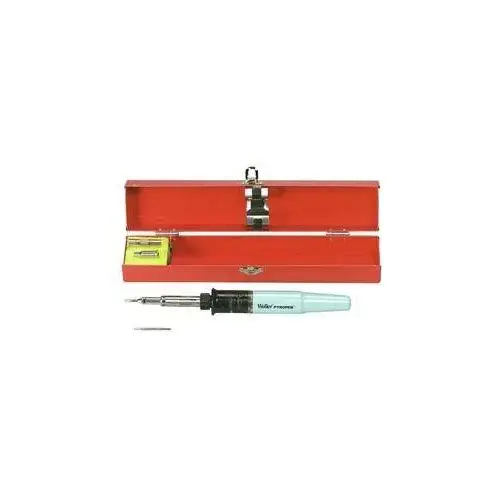
The Weller Pyropen 25 to 60 w soldering iron is sold 1 pack per case and is another quality product from Weller. This soldering iron is designed to work with WB1 - Butane Refill, WB2 - Butane Refill. Provides an output wattage of 25 to 60 w.
Specifications:
Specification parameters description:
System..Application:
Soldering Soldering is the process of joining metal components together using a metal filler, called a solder. Soldering connects electrical wire and components to printed circuit boards (PCB). The solder must have a lower melting point than the component’s melting point or damage to the component can occur. Before soldering, components must be cleaned of rust, dirt and other contaminants before a flux can be applied to remove surface oxides. The components are then heated, the flux is applied and the melted solder flows out of the soldering iron and joins the components.
Specifications:
For Use With:
- WB1 - Butane Refill
- WB2 - Butane Refill
Supplied Tips:
- WHC51
- WPT2
Specification parameters description:
System..Application:
Soldering Soldering is the process of joining metal components together using a metal filler, called a solder. Soldering connects electrical wire and components to printed circuit boards (PCB). The solder must have a lower melting point than the component’s melting point or damage to the component can occur. Before soldering, components must be cleaned of rust, dirt and other contaminants before a flux can be applied to remove surface oxides. The components are then heated, the flux is applied and the melted solder flows out of the soldering iron and joins the components.