RECENTLY VIEWED
Skip to main content
DK Hardware Professional Tax Exempt? Net 30? - DK Net Terms
Roll over image to zoom in
Product Features
Product Overview
Related Videos
Reviews
Questions & Answers
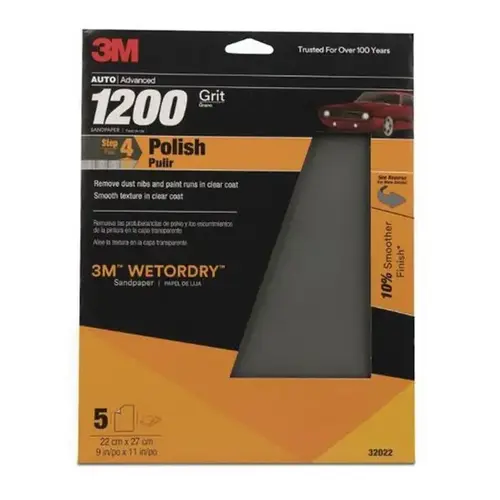
Wetordry 32022 Sandpaper, 9 in W x 11 in L, 1200 Grit, Aluminum Oxide Abrasive, Gray, Wet/Dry
Item #: 32022 by 3M
UPC #: 051131320222
See reviewsSee reviews
30 Days Easy Return. We are the largest supplier of the most adaptable, personalized hardware in the industry. We work hard to ensure you're satisfied with our products.
Features
- Full range of grades is ideal for aggressive or refined auto sanding
- Silicon carbide abrasive self-fractures for longer life
- Flexible lightweight paper conforms to auto body surfaces for consistent finishes
- Delivers 10% smoother finish vs. conventional 3M™ sandpaper
- Use as part of the 3M™ body repair system
- Use for wet sanding and dry sanding without switching sandpaper
Application
For paint preparation, smoothing of clear coats
Grit
1200
Abrasive Material
Silicon Carbide
Wet/Dry
Wet/Dry
Width (in)
9
Length (in)
11
Part no.
32022
MFR Model
32022
Backing Material
Paper
Color/Finish
Gray
Overall Length
11"
Grade
Super Fine
Overall Width
9"
Color
Gray
Package Quantity
5 sheets per pack
Attachment Type
None
Trade Name
Wetordry
Backing Weight
A
Product Form
Sheet
Alternative UPC
60455057517
Product Overview
Wet sanding and dry sanding each have their own advantages for sanding effectiveness, time savings and creating a professional-grade finish for your auto body repairs. Wet sanding helps keep dust out of the air and reduces clogging of the sandpaper which can slow you down and cause unwanted scratches in the surface. Wet sanding is generally done during the more refined stages of body repair. Dry sanding tend to remove stock from the surface faster and saves you from having to continually dry the surface - you can instantly check the progress of your work. Our 3M™ Wetordry™ sandpaper saves you time and hassle right from the start. It allows you to keep just one sandpaper on hand and to eliminate extra time switching between sandpapers, even if your project requires both dry and wet sanding.
3M Wetordry sandpaper uses silicon carbide as the abrasive material. 3M incorporates this silicon carbide material into the sandpaper forming a grit of 1200. The none attachment allows for easy mounting to the tool or pad. The sandpaper has a width of 9 in and length of 11 in. This item is on a paper backing, A weight.
Specification parameters description:
Backing Weight:
Paper and cloth have a lettering scale for backing weight that measures strength of the material onto which the abrasive is mounted. Paper uses the letters A-F, where A is a lighter weight and most flexible and F represents a rigid, heavier backing. Lighter backings are typically paired with finer abrasive grits, suitable for blending and finishing. Coarser grits used for deburring and stock removal rely on a heavier backing. Cloth uses a lettering system of J, X, and Y for backing weight. J weight (jeans) is the lightest and most flexible, X weight (drills) is more durable and recommended for medium duty work, and Y weight is the toughest and least flexible. Fiber backings are made from chemically-impregnated paper to form a very hard, strong backing material. Fiber is used primarily for sanding discs. Polyester film backing provides high strength with a very thin backing and is used for very fine grits. It is more tear resistant than paper backing and is also waterproof.
Grade:
Grade is a measurement of the size of abrasive particles embedded in coated abrasives. It is a more general measurement of the level of precision, and corresponds roughly to grit. A smaller grit number means larger particles and a coarser grade, while high number grits are used for finer work.
Grit:
Grit is a measurement of the size of abrasive particles embedded in coated abrasives. The most common standards for grit size are the United States CAMI (Coated Abrasive Manufacturers Institute) and the European FEPA (Federation of European Producers of Abrasives). A smaller grit number means larger particles and a coarser grade, while high number grits are used for finer work. Grit is generally a unitless measure but is sometimes measured in microns.
3M Wetordry sandpaper uses silicon carbide as the abrasive material. 3M incorporates this silicon carbide material into the sandpaper forming a grit of 1200. The none attachment allows for easy mounting to the tool or pad. The sandpaper has a width of 9 in and length of 11 in. This item is on a paper backing, A weight.
Specification parameters description:
Backing Weight:
Paper and cloth have a lettering scale for backing weight that measures strength of the material onto which the abrasive is mounted. Paper uses the letters A-F, where A is a lighter weight and most flexible and F represents a rigid, heavier backing. Lighter backings are typically paired with finer abrasive grits, suitable for blending and finishing. Coarser grits used for deburring and stock removal rely on a heavier backing. Cloth uses a lettering system of J, X, and Y for backing weight. J weight (jeans) is the lightest and most flexible, X weight (drills) is more durable and recommended for medium duty work, and Y weight is the toughest and least flexible. Fiber backings are made from chemically-impregnated paper to form a very hard, strong backing material. Fiber is used primarily for sanding discs. Polyester film backing provides high strength with a very thin backing and is used for very fine grits. It is more tear resistant than paper backing and is also waterproof.
Grade:
Grade is a measurement of the size of abrasive particles embedded in coated abrasives. It is a more general measurement of the level of precision, and corresponds roughly to grit. A smaller grit number means larger particles and a coarser grade, while high number grits are used for finer work.
Grit:
Grit is a measurement of the size of abrasive particles embedded in coated abrasives. The most common standards for grit size are the United States CAMI (Coated Abrasive Manufacturers Institute) and the European FEPA (Federation of European Producers of Abrasives). A smaller grit number means larger particles and a coarser grade, while high number grits are used for finer work. Grit is generally a unitless measure but is sometimes measured in microns.