


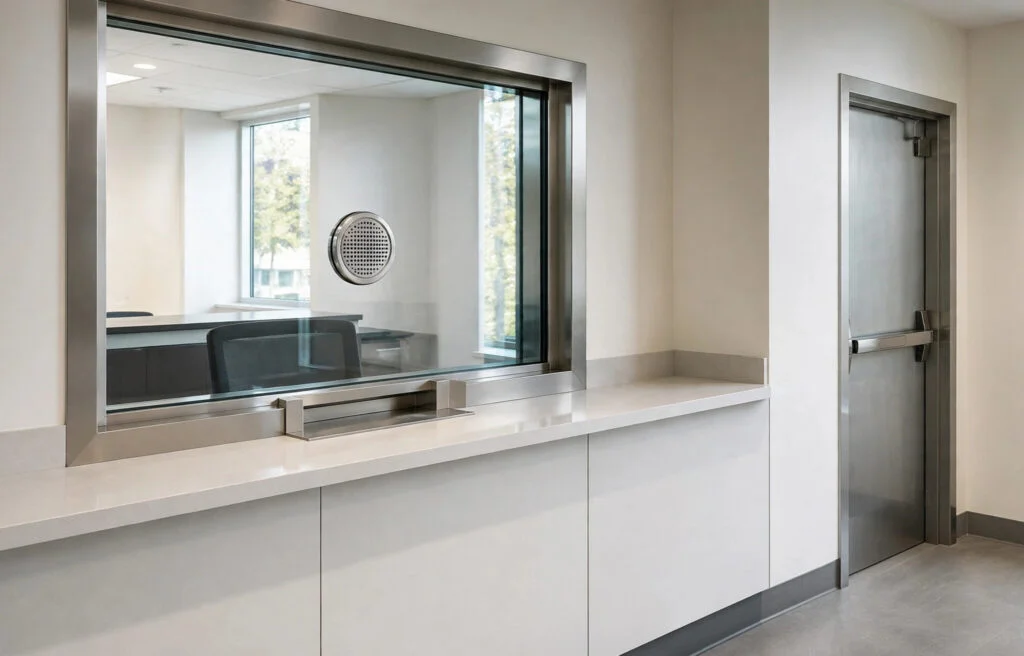
A 36 in. × 48 in. (914 × 1,219 mm) transaction window is the most-quoted ballistic opening in North America because it is the size that fits a cashier counter, a pharmacy pass-through, a dispensary reception desk and a municipal payment window. At UL 752 Level 1 that unit lists at roughly $3,900 as a factory-glazed acrylic frame; at Level 3 in laminated glazing it is about $4,600; add a deal tray, a speak-thru, the fiberglass panel below the counter and a crew to set it, and the same opening lands at $7,000–$12,000 installed. Almost everything about bullet proof windows cost follows from that pattern: the rated lite is a third of the number, and the frame, the hardware and the wall around it are the rest. Buyers asking how much are bulletproof windows usually get a per-square-foot figure; the assembly is what turns it into a per-opening quote.
The figures below come from published US fabricator and installer pricing, cross-checked against list prices for factory-glazed bullet resistant windows, ballistic glazing and frames. Treat them as planning ranges: bullet proof windows cost more in high-labor metros and wherever freight on a crated 200 lb (91 kg) unit is billed by the mile.
Quick Answer
How much do bulletproof windows cost?
Bullet proof windows cost $2,700–$4,900 per factory-glazed Level 1–3 transaction window before installation, $7,000–$12,000 installed for a single rated counter, $15,000–$30,000 for a multi-window bank or retail counter, and $5,000–$25,000 per opening for custom residential units. Material alone runs $30–$100/sq ft at Level 1–2 and $400–$500+/sq ft at rifle levels.
How Much Are Bulletproof Windows Compared to Standard Storefront Glazing?
How much are bulletproof windows next to the 1/4 in. (6 mm) tempered lite in an ordinary storefront or the vinyl double-hung in a house? Bullet proof windows cost 10 to 30 times more per opening. A standard aluminum storefront lite glazes for a few hundred dollars; the same 36 in. × 48 in. opening as a Level 1 fixed ballistic unit starts near $3,900 uninstalled, and a Level 8 rifle-rated unit in a residential casement exceeds $14,000.
The spread is not marketing. A rated window is a system: the glazing, the frame, the sash, the deal tray and the anchoring all have to stop the same round, because a bullet that passes through an unrated mullion next to Level 3 glass has still reached the cashier. That is why the cost of bullet proof windows is quoted per opening and custom, why bullet proof windows for house projects start with your opening dimensions and required level rather than a catalog price, and why bulletproof glass cost alone tells you little about the final bill.
What Drives Bullet Proof Windows Cost?
Five variables decide what bullet proof windows cost, in this order of impact: the UL 752 level (the UL Solutions rating that names which round the glazing stopped in testing), the glazing material, the size of the lite, whether the window opens or has pass-through hardware, and how much of the surrounding wall or counter has to be rebuilt to carry it.
- Rating level. Every step up UL 752 adds thickness and weight. Level 1 stops a 9 mm handgun round; Level 3 stops a .44 Magnum; Level 8 stops five rounds of 7.62 mm rifle fire. Level 3 glazing is about 1-1/4 in. (32 mm) thick; Level 8 can pass 2-1/2 in. (64 mm). Retail counters, gas stations and pharmacies are almost always specified at Level 1–3; courthouses, government lobbies and some school entries go to Level 4–8.
- Material. Acrylic is the cheapest and lightest option at handgun levels and is what most stock transaction windows use; polycarbonate tops out at Level 3; glass-clad polycarbonate (GCP) is the only common choice at rifle levels. Insulated ballistic units with a low-E or solar-control cavity raise bulletproof glass cost by 10–30 percent over monolithic sheets.
- Size. Price is per square foot, but weight rises with area, so a 48 in. × 72 in. (1,219 × 1,829 mm) lobby lite needs heavier framing and lifting equipment, not just more glass. Stock transaction sizes (24 × 36, 36 × 36, 36 × 48 in.) are the cheapest per square foot because nothing is custom.
- Operability and pass-through hardware. A fixed lite is the floor. A horizontal slider or a residential casement with concealed ballistic steel, ball-bearing hinges and multi-point locking bolts can double what bullet proof windows cost at the same size. On a counter, a rated deal tray adds roughly $90 at Level 1 and $190 at Level 3, and a speak-thru or package passer adds more.
- Structure. Counters framed in 2×4s and rough openings in wood-frame houses were sized for 30–50 lb (14–23 kg) sashes. A 200 lb (91 kg) ballistic unit often needs a steel sub-frame, a new header or added king studs; bulletproof windows for home retrofits meet the same problem in a bedroom wall.
Bullet Resistant Glass Levels and What Each Costs Per Square Foot
Bullet resistant glass levels under UL 752 run from 1 to 8 for commercial and residential glazing, and bulletproof glass cost per square foot climbs steeply from Level 3 to Level 4 because the construction changes from handgun laminates to rifle-rated glass-clad polycarbonate. Round, velocity and shot-count data follow the UL 752 Standard for Bullet-Resisting Equipment (11th edition numeric levels); thickness and weight per level follow the UL 752 level summary hosted by the Wisconsin Department of Administration.
UL 752 Level | Round Stopped in Test | Typical Material | Glazing Thickness | Weight (lb/sq ft) | Material Cost (per sq ft) | Where It Is Usually Specified |
1 | 9 mm FMJ, 124 gr, ~1,175 fps, 3 shots | Acrylic, polycarbonate or GCP | 3/4–1-1/4 in. (19–32 mm) | 4.6–9 | $30–$100 | Gas stations, convenience stores, pharmacies, ticket booths |
2 | .357 Magnum, 158 gr, ~1,250 fps, 3 shots | Acrylic, polycarbonate or GCP | 7/8–1-3/8 in. (22–35 mm) | 6.4–10.5 | $50–$120 | Check cashing, dispensaries, hotel night windows |
3 | .44 Magnum, 240 gr, ~1,350 fps, 3 shots | Acrylic, polycarbonate or GCP | 1–1-1/4 in. (25–32 mm) | 7.7–11.5 | $90–$180 | Banks, jewelers, police lobbies, safe rooms |
4 | .30-06 soft point, 180 gr, ~2,540 fps, 1 shot | Glass-clad polycarbonate | 1-1/4–2 in. (32–51 mm) | 14.5–18 | $180–$350 | Courthouses, government offices |
5 | 7.62 mm FMJ, 150 gr, ~2,750 fps, 1 shot | Glass-clad polycarbonate | 1-1/4–2-1/4 in. (32–57 mm) | 14.4–22 | $200–$350 | Corporate lobbies, utilities |
7 | 5.56 mm FMJ, 55 gr, ~3,080 fps, 5 shots | Glass-clad polycarbonate | 1-15/16–2-1/2 in. (49–64 mm) | 22–26 | $400–$500+ | School entries, embassies, military |
8 | 7.62 mm FMJ, 150 gr, ~2,750 fps, 5 shots | Glass-clad polycarbonate | 2–2-1/2+ in. (51–64+ mm) | 22–29 | $400–$500+ | Embassies, federal facilities |
Quick Tip
Level 6, a five-shot 9 mm submachine-gun test, is left out because building projects almost never specify it. Material matters as much as level for weight: an all-glass laminate can weigh 26 lb/sq ft at Level 2, more than a glass-clad polycarbonate lite rated to Level 8, so ask for the data sheet of the specific product, not just the level.
Bullet resistant glass levels 1–3 cover the realistic threat to a retail counter or a house (handguns) and keep the glazing under 1-1/4 in. (32 mm), which matters because stock aluminum transaction frames and residential hinges cannot carry anything heavier. Rifle levels are the right specification for courthouses, agency lobbies, safe rooms and street-facing elevations with a documented rifle threat; matching bullet resistant glass levels to the actual threat per opening is what keeps bullet proof windows cost at the first estimate rather than twice it.
Bulletproof Glass Cost Vs. the Installed Price of the Window
Bulletproof glass cost is the sheet price only; what bullet proof windows cost to install is usually two to three times that figure once the rated frame, pass-through hardware, structural work and labor are added. The frame alone doubles the number before anyone lifts a tool: a complete Level 3 36 in. × 48 in. unit lists at about $390 per sq ft against $120–$180 for the glazing inside it.
A worked example for a Level 3 fixed transaction window, 36 in. × 48 in. (12 sq ft), set into an existing counter wall:
- Glazing: 12 sq ft × $120–$180 = $1,450–$2,150
- Rated aluminum frame with steel-lined channel, factory glazed: $2,000–$3,000 (a complete Level 3 unit in this size lists at about $4,600 from TSS, which covers both lines)
- Level 3 deal tray and speak-thru: $300–$600
- Fiberglass barrier panel below the counter, 4 ft × 8 ft at Level 3: $1,000–$2,100
- Structural work (steel sub-frame or header, counter rebuild, trim): $500–$2,000
- Installation labor: $75–$200 per linear foot of perimeter, so 14 ft × $75–$200 = $1,050–$2,800
- Total installed: roughly $7,000–$12,000
Bulletproof glass cost in that example is under a third of the total. Retail list prices for complete, factory-glazed bullet resistant transaction windows bear that out: 24 in. × 36 in. to 36 in. × 48 in. units run roughly $2,700–$3,900 for Level 1 acrylic, about $4,600 for Level 3 laminated and close to $4,900 for a Level 2 unit in an anodized aluminum frame, which works out to $320–$820 per sq ft before installation, and a 36 in. × 36 in. exchange window with a rotary server lists above $8,000.
How much does a bulletproof window cost once it has to open? A horizontal ballistic slider for a drive-through lists around $3,300 at Level 1; a residential casement with concealed steel and a multi-point bolt system lands nearer $9,000–$14,000 installed. The casement and awning window hardware guide explains why operator and lock choice matters more on a heavy sash; none of the existing sash locks and window hardware carries over, and standard window channel balances are sized for sashes under about 50 lb (23 kg).
Bullet Proof Glass Installation Cost by Method
Bullet proof glass installation cost depends on whether the fabricator ships a complete pre-glazed unit or a bare lite for a local glazier to frame. Complete units carry a higher bullet proof glass installation cost up front but install like a heavy replacement window; any commercial glazier or crew that has set a large impact window can set one, and the UL 752 rating stays with the manufacturer. Field-glazing a bare Level 3 lite into a site-built channel is cheaper on paper, slower in practice, and puts the frame rating on the installer.
What a Rated Counter, Storefront or Lobby Costs as a System?
A single window is rarely the whole job on a commercial site, because a barrier holds its UL 752 rating only if every panel, sash, channel and clamp in the assembly matches the glazing level. Priced as a system, bullet proof windows cost what the table shows; priced as a lite, they arrive as a change order.
| Installation | Typical Scope | Glazing Level | Installed Cost Range |
| Gas station or convenience store counter | One 36 × 48 in. transaction window, deal tray, speak-thru, fiberglass below counter | Level 1–2 | $7,000–$12,000 |
| Pharmacy or dispensary pass-through | One or two windows, package passer, rated door to back room | Level 1–3 | $10,000–$20,000 |
| Bank or check-cashing counter | Three to five teller windows, continuous fiberglass, rated door with access control | Level 3 | $15,000–$30,000+ |
| Reception or lobby wall | Floor-to-ceiling lites, ballistic wall panels, vestibule door | Level 3–8 | $50,000 to six figures |
| Residential opening (fixed) | One custom window, steel-reinforced frame, engineered header | Level 1–3 | $5,000–$11,000 |
| Residential opening (operable, bedroom egress) | One casement or hung unit with concealed steel sash | Level 1–3 | $7,000–$14,000 |

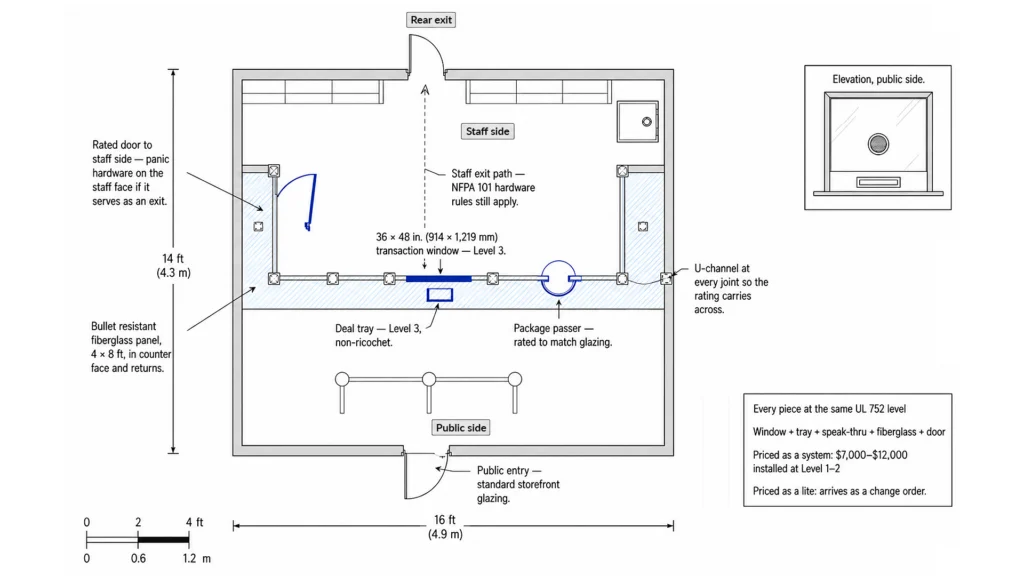
Three cost lines are easy to miss on a commercial job. Bullet resistant fiberglass wall panels under and beside the glazing list at roughly $17–$35 per sq ft at Level 1–3 and under $90 per sq ft at Level 8, far cheaper than glazing, but they need their own U-channel and batten strips so joints stay rated. A ballistic door behind the counter starts near $3,500 at Level 1 and still has to meet NFPA 101 egress hardware rules if it sits in a required exit, which usually means a rated panic exit device rather than a deadbolt. And the transaction window buying guide covers the speak-thru, tray and night-window choices that decide whether staff can actually work behind the barrier.
Is Bullet Proof Glass Expensive Because of the Glass or the Frame?
Is bullet proof glass expensive on its own? Yes, but on both a storefront and a house the frame and structure surprise people more than the glass, and they are where bullet proof windows cost overruns come from. A rated frame is welded steel or aluminum with a continuous steel insert, anchored with 3/8 in. (10 mm) or larger fasteners at 12–16 in. (305–406 mm) centers into framing, CMU or steel studs that can take the load. Buy structural screws, bolts and anchors to the fabricator’s schedule, not to whatever the existing window used.
What the Price Buys?
What bullet proof windows cost is a one-time purchase. Acrylic and glass-clad polycarbonate hold their UL 752 rating for the life of the unit as long as the edge seal stays intact and the sheet is not cracked, so there is no recurring cost, no re-certification and no replacement cycle; security film, by comparison, carries a limited-term warranty and is re-applied when it fails. Insurers price armed-robbery exposure for cash-handling businesses, and a rated counter is a standard underwriting question for them; ask the carrier which UL 752 level it recognizes before ordering.
A factory-glazed unit also arrives with the manufacturer’s UL 752 test report for the complete assembly, glazing and frame together. Film, laminated glass and site-built frames cannot offer that document, and it is the document an insurer, a licensing inspector or a landlord will ask to see. Stock transaction sizes are the cheapest per square foot in the whole category, ship in 2–4 weeks, and installed with an ordinary glazing crew, so a small business can put a rated barrier between staff and the public inside a single fit-out budget.
Cheaper Alternatives, and What They Actually Stop
Not every security goal needs a rated window. Is bullet proof glass expensive relative to a burglary threat? Yes, and the question of how much do bulletproof windows cost often ends with a cheaper product that fits the actual threat, whether that is a smash-and-grab at a storefront or a break-in at a house. The table compares what the options cost installed and what each one is tested to do.
| Option | Installed Cost | Tested Against | Stops Handgun Rounds? | Retrofit to Existing Frame? |
| 8–14 mil security window film with attachment sealant | $8–$25/sq ft | Forced entry delay, glass retention (ANSI Z97.1, CPSC 16 CFR 1201) | No | Yes |
| Laminated security glass (annealed glass + PVB, up to 3/8 in. / 10 mm) | $40–$100/sq ft | Forced entry (ASTM F1233), impact (ASTM E1886/E1996) | No | Usually, with new IGU |
| Forced-entry window with polycarbonate layer | $300+/sq ft | Forced entry; some pass UL 752 Level 1 | Sometimes (Level 1 only) | No, full replacement |
| Full ballistic replacement window | $350–$800+/sq ft | UL 752 Levels 1–8 | Yes | No, full replacement |
Match the product to the threat. After-hours forced entry at a storefront is a laminated-glass and lock problem: laminated lites plus a rated deadlock and a reinforced strike from the locks and accessories range cover it, and the guide to choosing door and window locks for home security covers the lock grades for a house. An armed robbery at a staffed counter is a UL 752 problem, and only a rated window and barrier answer it; what bullet proof windows cost buys protection for the person behind the glass, which none of the cheaper options in the table are tested to provide.
Bulletproof Windows for Home Use: Code, Egress and Energy Issues That Change the Price
Bulletproof windows for home installation run into three code problems that commercial projects do not, and each adds to what bullet proof windows cost.
- Bedroom egress – IRC R310 requires an emergency escape and rescue opening in every sleeping room: 5.7 sq ft (0.53 m²) net clear opening, minimum 24 in. (610 mm) high and 20 in. (508 mm) wide, sill no more than 44 in. (1,118 mm) above the floor. A fixed ballistic lite in a bedroom fails unless another compliant opening exists, so bedrooms need operable rated units, the most expensive type of bulletproof windows for home use. Canada’s NBC 2020 Article 9.9.10.1 (Alberta Safety Codes Council summary) asks for an unobstructed opening of at least 0.35 m² (3.8 sq ft) with no dimension under 380 mm (15 in.), and the sash must open without tools.
- Energy code – A monolithic 1-1/4 in. (32 mm) acrylic sheet insulates about like single-pane glass. The 2021 IECC caps residential fenestration U-factor at 0.30 in climate zones 3–8 and 0.40 in zone 2, with a separate value for the hot zones 0–1; states and cities adopt different editions of the IECC and amend them, so confirm the edition and the table your building department enforces before specifying. Canadian provinces reference NAFS (AAMA/WDMA/CSA 101/I.S.2/A440) plus NRCan U-factor tiers. Meeting that means an insulated ballistic unit, 1-1/8 in. (29 mm) at Level 1 to 1-13/16 in. (46 mm) at Level 4–5, with a low-E coating, which costs more than a monolithic sheet and weighs more. Ballistic fabricators offer low-E coatings and sealed airspaces but publish no NAFS or NFRC energy-performance label for the units, so plan for an alternative-compliance letter from the fabricator or the building official. Interior transaction windows in a conditioned commercial space skip this problem entirely, which is one reason they cost less.
- Wind and impact zones – A ballistic rating is not a hurricane rating. In Florida’s High-Velocity Hurricane Zone and coastal Texas, Louisiana and the Carolinas, bullet proof windows cost more on an exterior wall because the assembly still needs a product approval (Florida Product Approval or Miami-Dade NOA, tested to TAS 201/202/203 or ASTM E1886 and ASTM E1996). Some rifle-level GCP passes large-missile impact, but the frame and anchorage are tested as an assembly, and few residential ballistic fabricators hold those approvals.
Can You Put Bulletproof Windows on a House Without Rebuilding the Wall?
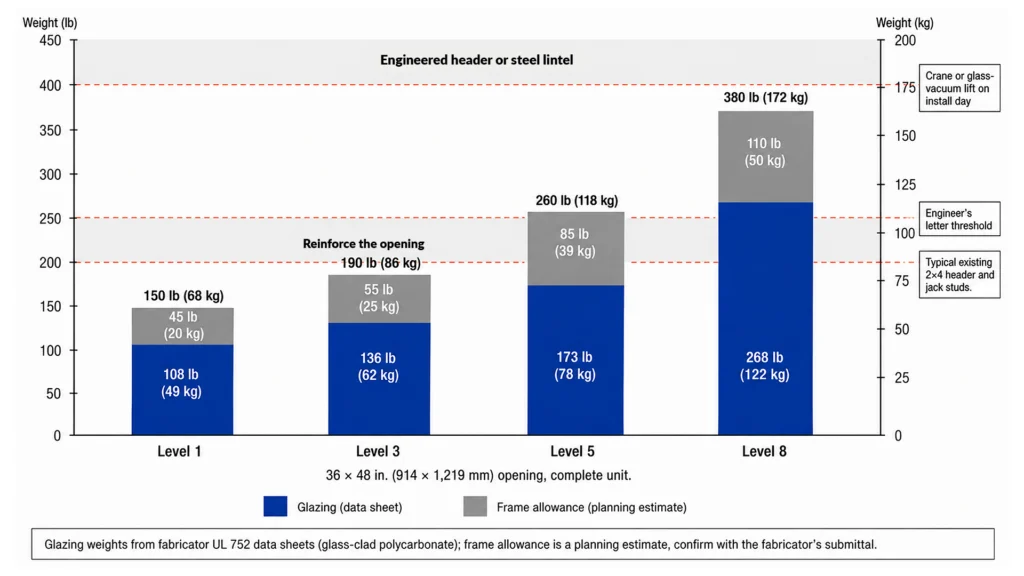
Can you put bulletproof windows on a house built with standard 2×4 or 2×6 wood framing? Yes, at handgun levels, with reinforcement at the opening. A Level 1–3 unit of ordinary bedroom size weighs 120–200 lb (54–91 kg) complete, which existing headers in most homes will carry, but the jack studs and sill need to be solid, and the anchors need 2-1/2 in. (64 mm) of embedment into framing rather than into sheathing. That reinforcement is a small share of the cost of bullet proof windows for house retrofits at handgun levels.
Rifle bullet resistant glass levels are different. A 48 in. × 72 in. Level 8 picture window can pass 700 lb (318 kg) with its frame (Level 8 laminate runs 24–29 lb/sq ft before framing). That needs an engineered header, often a steel lintel in masonry, and a crane or glass-vacuum lift on install day. Budget for a structural engineer’s letter, which many building departments will require before issuing the permit.
Bullet proof windows for house security work best as part of a hardened envelope: pair the rated openings with a rated deadbolt and a reinforced strike on each entry door from the deadlocks and deadlatches range, and keyed casement latches and window locks on the ground-floor openings that are not rated, so the window you paid for is not bypassed through the door beside it.
Frequently Asked Questions
How much does a bulletproof window cost on its own? A single Level 1–2 transaction window with deal tray and speak-thru costs $7,000–$12,000 installed; a single operable Level 1–3 bedroom window costs $7,000–$14,000 installed, because bedrooms need an opening sash to meet egress, and that is the honest answer to how much are bulletproof windows for most buyers. A fixed unit in a non-sleeping room or an interior office wall at the same size and level runs $5,000–$11,000.
No model building code in the US or Canada requires ballistic glazing in ordinary commercial occupancies, so bullet proof windows cost is a business decision, not a permit condition. The rating is driven by the insurer, the franchisor, a lender’s security condition, or an agency specification such as federal courts and GSA-leased space; state cannabis and check-cashing security rules specify cameras, vaults and alarms, not ballistic glazing. What code does govern everything around the barrier: exit hardware on rated doors, accessible counter height and reach at the pass-through under ADA or provincial accessibility rules, and fire-rated wall assemblies where fiberglass panels are added.
They answer different threats, and the two are usually combined. Bullet proof windows cost $7,000–$14,000 each and protect a person who has to be at that opening: a cashier at a counter, a receptionist at a lobby desk, a family in a street-facing room. A safe room built from Level 3 bullet resistant fiberglass wall panels, which list at roughly $30–$65 per sq ft, and a rated door protects people who can retreat to it. A staffed counter needs the window; a home with a documented threat usually needs one or two rated openings on the exposed elevation plus a safe room, and bulletproof windows for home protection across every opening is rarely the specification a fabricator will recommend.
No. 3M makes no bulletproof film; the 3m bulletproof window film cost people search for is the price of 8 mil or 14 mil security film, about $8–$25/sq ft installed plus $0.50–$2 per linear foot for the silicone attachment bead at the frame. It holds broken glass in place and slows a break-in, and no film carries a UL 752 rating on ordinary glass. If the threat is burglary rather than gunfire, film plus better locks is the cost-effective path.
The cost of bullet proof windows is lower when they are specified correctly the first time than when they are reordered, so gather the following before you order:
- Measure each opening’s rough width and height to 1/8 in. (3 mm), and the wall or counter thickness from interior face to exterior face; the windows and door hardware range covers the sash, balance and lock parts that will not carry over.
- Decide the level per opening from the bullet resistant glass levels table (Level 1–2 for a retail counter or handgun threats on a ground-floor elevation; Level 3 for a bank, jeweler or safe room; rifle levels only with a documented threat or an agency spec) and, on a commercial counter, list the pass-through hardware now so every piece is quoted at the same UL 752 level as the glazing.
- Mark which residential openings are in sleeping rooms and must stay operable for IRC R310 or NBC 9.9.10.1 egress, which commercial doors sit in a required exit and need rated exit hardware, and, for exterior openings, whether your climate zone’s U-factor or a Florida HVHZ product approval applies.
- Have a framing contractor open the interior trim on one opening to confirm header size and stud or CMU condition; this is the step that answers whether you can put bulletproof windows on a house like yours, or into a counter wall built in 2×4s. Get an engineer’s letter if any unit will exceed 250 lb (113 kg).
- Price the alternatives for the same openings and compare them with bulletproof glass cost at your level: security film with attachment sealant for burglary resistance, laminated glass where impact is the concern, and rated door and window security hardware on the entry doors, which most intruders use first.
- Check the product’s spec sheet for the UL 752 test report on the complete assembly, not the glass alone, and confirm whether the bullet proof windows cost listed covers a pre-glazed unit or a bare lite for field framing.
Bullet proof windows for house projects and rated counters are not a one-person job. Call a pro when a unit will exceed 250 lb (113 kg), when the opening is in a masonry, stucco or steel-stud wall, or when the building sits in a hurricane zone; in all three cases the anchoring detail is the difference between a rated barrier and an expensive pane leaning in a hole.
Delay fertilization until 48 to 72 hours after heavy rain to prevent runoff. Hold off on aeration if soil is saturated. Watch for circular discolored patches that may indicate fungal pressure. Treat those before fertilizing.