Manual vs Electric Snow Blowers: Which One Is Right for Your Property?

Extreme winter conditions bring snow-covered driveways, slippery walkways, and blocked entrances which can turn into safety issues if they’re not handled on time. That’s where having the right snow-clearing equipment matters.
If you’re stuck choosing between a manual and an electric snow blower, you’re not alone. Both options can handle snow effectively in the right conditions, but choosing the wrong one can leave you working harder than necessary, or frustrated halfway through your driveway.
Snow blowers generally fall into two broad categories:
- Manual snow blowers, which rely on push power
- Electric snow blowers, which use a motor to move snow
Both are commonly used alongside other snow removal tools depending on snowfall levels and surface conditions.
This guide breaks down manual vs electric snow blowers in simple, practical terms. We’ll cover how each type works, where they perform best, what they cost to own, and how to decide which one fits your property, not just on paper, but in real winter conditions.
What is a Manual Snow Blower?
A manual snow blower is one of the simplest and most budget-friendly snow-clearing tools you can use. Unlike a snow shovel, it rolls on wheels and clears snow by throwing it aside with a rotating auger, rather than lifting and tossing it by hand.
Instead of relying on motors, fuel, or electricity, it works entirely through forward motion, making it easy to understand and quick to deploy during light snowfall.
How Does a Manual Snow Blower Work?
As you push the unit, the auger rotates and scoops snow forward and to the side. The faster you push, the more efficiently it clears snow. Because it relies entirely on human effort, it works best when snow is light and fresh.
Advantages of Manual Snow Blowers
Manual snow blowers are often overlooked, but they offer clear benefits in the right situations, especially for homeowners who value low upkeep and are tight on budget.
Manual snow blowers are popular for several reasons:
- Lightweight and easy to maneuver
- Quiet operation
- No cords, batteries, or fuel
- Minimal maintenance
Limitations of Manual Snow Blowers
That simplicity does come with limits. Because a manual snow blower relies entirely on physical effort, performance drops as snow gets deeper, wetter, or more compacted.
That means:
- Requires physical effort
- Less effective in deep, wet, or packed snow
- Slower for large areas
- Not ideal for heavy snowfall regions
When Should You Buy A Manual Snow Blower?
A manual snow blower is a smart choice if you:
- Have a small driveway, walkway, or sidewalk
- Deal mostly with light to moderate snowfall
- Want a low-maintenance option
- Prefer a simple, grab-and-go solution
What is an Electric Snow Blower?
Electric snow blowers are designed for homeowners who want faster snow removal with less physical strain. By using an electric motor instead of push power, they bridge the gap between manual tools and larger gas-powered machines.
How Does an Electric Snow Blower Operate?
The motor drives the auger, which scoops and throws snow forward or to the side. Instead of relying on push speed, performance depends on motor power and auger design.
Benefits of Electric Snow Blowers
The main appeal of electric snow blowers is convenience. They take much of the physical work out of snow clearing while remaining easier to maintain than gas-powered models.
Electric snow blowers offer several advantages:
- Less physical strain
- Faster clearing for larger areas
- Consistent performance
- No gas or engine maintenance
- Easier cold starts compared to gas models
Drawbacks to Consider With Electric Snow Blowers
Despite their convenience, electric snow blowers aren’t perfect for every situation. Their performance depends heavily on power availability and snow conditions.
There are a few practical limits to keep in mind:
- Corded models require outlet access and cord management
- Cordless models depend on battery runtime
- Slightly more storage space required
Where do the Electric Snow Blowers Perform Best?
Electric snow blowers work well for:
- Medium to large residential driveways
- Areas with frequent snowfall
- Users who want faster clearing with less effort
- Walkways and multi-car driveways
Manual vs Electric Snow Blower: Key Differences
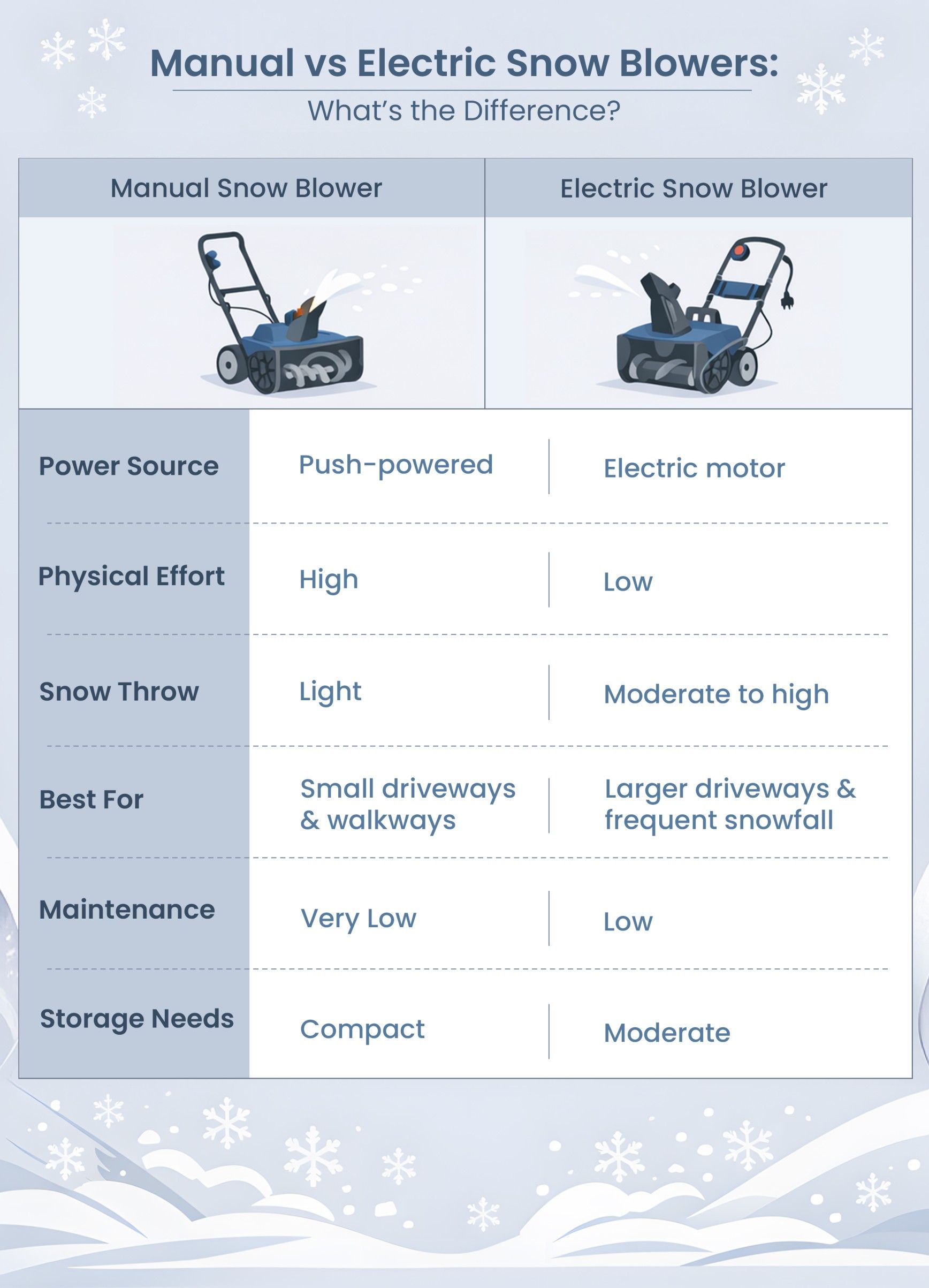
When comparing manual vs electric snow blowers, the real differences show up once you start using them regularly, not when you’re reading specs. Power, physical effort, time saved, and storage needs all play a role, especially after multiple snowfalls in a single season. This section breaks down where those differences matter most in day‑to‑day use.
All in all, if you’re clearing light snow from a small area once in a while, a manual snow blower is usually enough. If snow removal is a frequent task, your driveway takes time to clear or you’re planning to use the snow blower for a long time, an electric snow blower offers clear time and effort savings.
Choosing the Right Snow Blower for Your Property
The best snow blower isn’t about choosing the most powerful option—it’s about choosing the one that matches your space, snowfall, and routine. Looking at your property type makes the decision much clearer.
Snow Blowers for Small Driveways and Walkways
If you’re clearing a single-car driveway, sidewalks, or short walkways, a manual snow blower often gets the job done quickly, especially when snow is fresh. Electric snow blowers work well in small driveways and walkways too, and with minimal effort.
Snow Blowers for Larger Driveways and Heavier Snow
For longer driveways or repeated storms, electric snow blowers save time and reduce fatigue. They’re also more efficient when snow depth increases.
Residential vs Light Commercial Use
Homeowners typically find both options suitable depending on snowfall. Light commercial or shared properties benefit more from electric snow blowers due to speed and consistency.
Performance Factors That Matter When Buying a Snow Blower
Specs only matter when they translate into real-world performance. Understanding a few key factors helps you avoid buying more, or less, snow blowers than you actually need.
- Snow Depth and Clearing Capacity - Manual snow blowers work for under 6 inches of snow. Electric models, however, can handle deeper accumulations of snow.
- Clearing Width and Efficiency - Wider clearing paths reduce the number of passes needed. Electric models generally offer wider clearing widths.
- Performance in Different Snow Conditions - Powdery snow is easy for both types. Wet, heavy snow favors electric models, while ice often requires additional snow removal tools or ice melt.
Cost, Maintenance, and Storage Considerations
Beyond performance, ownership factors like cost, upkeep, and storage often influence long-term satisfaction. These details may seem minor, but they add up over multiple winters.
- Upfront Cost vs Long-Term Maintenance - Manual snow blowers are budget-friendly upfront. Electric models cost more upfront but save time and energy in the long run, and they require minimal upkeep compared to gas alternatives.
- Storage Space and Off-Season Care - Manual units fit easily in garages or sheds. Electric units may need dry storage for cords or batteries during off-season months.
- Maintenance Requirements Over Time - Manual models need occasional auger checks. Electric models may require battery care or cord inspections but avoid engine maintenance entirely.
Other Snow Removal Tools For a Clearer Pathway
Many homeowners combine snow blowers with other snow removal tools, including snow shovel and even ice melt products for slippery areas and compact push tools for tight spaces.
For full winter readiness, it also helps to be prepared beyond snow clearing. Having a cold weather repair kit on hand can help address frozen pipes and small emergencies during extreme cold.
You can also reduce winter-related damage by taking steps to prevent pipes from freezing and by improving home insulation and weatherproofing, especially around doors and entry points.
Conclusion: Which Snow Blower Should You Choose?
There’s no one-size-fits-all answer when it comes to choosing between a manual and an electric snow blower. The right choice depends on how much snow you deal with, how often you need to clear it, and how much physical effort you’re comfortable putting in after every storm.
A manual snow blower is a reliable, low-maintenance option for smaller spaces and lighter snowfall. It’s easy to store, quick to use, and gets the job done when conditions are manageable.
An electric snow blower makes more sense if snow removal is a regular task, your driveway is larger, or you want to save time and reduce strain. Over the course of a winter, that added convenience can make a noticeable difference.
Check out the best-quality snow blowers at DK Hardware & keep an eye on this space for more such informative blogs & buying guides. Don’t forget to follow us on Instagram, Facebook & Pinterest for instant hardware updates, and home improvement ideas.