



Which Bullet Proof Materials Are Used in Commercial Buildings?
Commercial buildings use clear and opaque materials based on the threat rating, location, visibility needs, and supporting assembly. The five most common options are listed below.1. Ballistic Glass and Glass-Clad Polycarbonate
Ballistic glass uses multiple glass plies and bonding interlayers to damage and slow a projectile while keeping fragments on the protected side within the test limit. Glass-clad polycarbonate adds a polycarbonate ply, often on the secure face, to catch fragments and reduce spall. Spall is material thrown from the rear face after impact. Published architectural products commonly span about 13/16 to 2-1/2 inches (21 to 64 mm) for glass-clad polycarbonate, depending on the tested threat. The actual make-up, supported panel size, framing bite, edge clearance, and installation orientation come from the approved shop drawings. Do not size the frame from glass thickness alone. Among clear bullet proof materials, this family suits:- Exterior storefronts and secure vestibules where daylight matters
- Bank and credit-union teller lines
- Government and courthouse service windows
- Pharmacy and hospital intake counters
- Guard booths and controlled entrances
2. Acrylic and Laminated Polycarbonate
Acrylic and polycarbonate are clear plastics used in interior barriers where lower panel mass, machining, and visibility matter. Acrylic is stiff and optically clear. Laminated polycarbonate flexes more under impact and usually offers stronger resistance to repeated blunt-force attack. Representative product ranges show acrylic at roughly 1-1/4 to 1-3/8 inches (32 to 35 mm) and laminated polycarbonate at about 3/4 to 1-1/4 inches (19 to 32 mm) for common handgun-rated configurations. Those figures are comparison points only. The tested product data controls. These bullet resistant building materials work well at indoor reception windows, service counters, interior doors, and secure partitions. Compared with glass-heavy bulletproof building materials, they can reduce panel mass and simplify some interior framing. Their practical limits deserve equal attention:- Abrasive cleaners can haze or scratch an unprotected face
- Ammonia, ketones, and other incompatible chemicals can cause surface damage or stress cracking
- Some products need a hard coat for public-facing use
- Exterior placement requires written UV and weather exposure approval
- Field holes and notches must stay within the fabricator’s approved details
3. Fiberglass Composite Panels
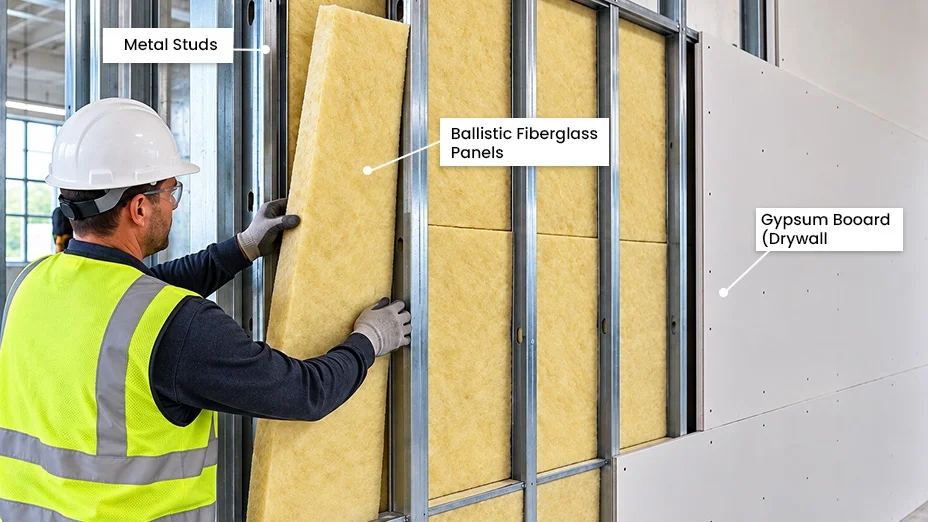
Ballistic fiberglass panels use woven glass fibers saturated with thermoset resin, pressed into rigid sheets. On impact, the layers separate in a controlled way and spread the projectile’s energy through a wider area. This delamination lets the panel catch the projectile without an exposed hard plate that may create ricochet. Commercial products are commonly sold in 3-by-8-foot, 3-by-10-foot, 4-by-8-foot, and 4-by-10-foot sheets. Published product families run from about 0.245 to 1.54 inches (6 to 39 mm) thick and roughly 2.55 to 16.02 pounds per square foot (12.4 to 78.2 kg/m²), depending on rating. Confirm every value from the selected product data. Fiberglass is one of the most practical bulletproof materials for walls because crews can hide it behind gypsum board, millwork, veneer, or other approved finishes. It is also used inside transaction counters, podiums, desks, doors, and protected rooms. Among opaque bullet resistant building materials, fiberglass fits many occupied-space retrofits without exposed metal. Installation details decide whether the wall works as intended:- Lap or back every vertical and horizontal seam as shown in the tested detail
- Continue coverage below counters and above accessible ceiling lines when the risk assessment requires it
- Use the stated fastener type, diameter, spacing, and edge distance
- Back electrical boxes, data outlets, pass-throughs, and other openings with approved protection
- Seal the transition into rated doors, frames, glazing, floors, and adjoining walls
4. Ballistic Steel
Ballistic steel provides high resistance in a thinner profile than many fiber or glazing systems. Fabricators use it in hollow-metal door and frame assemblies, counters, guard enclosures, equipment rooms, wall inserts, and narrow areas where a thick panel would conflict with trim or equipment. It is one of the densest bulletproof building materials, so support and handling affect cost and schedule. “Steel plate” is not a complete specification. Alloy chemistry, hardness, heat history, plate thickness, shot direction, weld design, edge support, and attachment method affect performance. Substituting ordinary mild steel of the same thickness is unsafe unless the exact assembly has test or engineering support. Steel asks more of the structure and the installer. A 4-by-8-foot sheet can require lifting equipment even at modest thickness. Field cutting creates hot work, can damage protective coatings, and may change an approved detail. Coastal and exterior sites also need a corrosion system compatible with cut edges, welds, fasteners, and dissimilar metals. An exposed hard face may deflect projectile fragments. Many designs place steel behind a finish layer or pair it with an anti-ricochet facing specified by the security engineer. These construction details separate engineered ballistic building materials from improvised plate reinforcement. Steel bullet proof materials should arrive with approved fabrication and attachment details. This rule applies to all bulletproof building materials that depend on concealed supports.5. Reinforced Concrete and Fully Grouted CMU
Reinforced concrete and fully grouted concrete masonry units, or CMU, can serve as opaque ballistic walls in new construction. Their mass suits secure rooms, police and government facilities, utility sites, data centers, loading areas, and perimeter zones. Among permanent bulletproof building materials, they may also satisfy structural, fire-separation, and acoustic duties when each assembly has the required documentation. Ordinary concrete and hollow blocks should not be assumed to resist a stated firearm threat. Compressive strength alone does not define ballistic performance. Aggregate, reinforcement, wall thickness, grout, hollow cells, mortar joints, support span, impact angle, repeated shots, and rear-face debris all affect the result. A nominal 8-inch (203 mm) CMU wall, for instance, can contain hollow cells, partial grout, conduit chases, control joints, and unprotected openings. Its construction may differ sharply from the specimen behind a published test. Concrete and masonry become credible bullet resistant building materials only with a project-specific tested assembly or an engineer’s design based on the stated threat and construction details. Retrofit work is rarely simple. Added concrete or grout increases dead load, may require foundation review, and can conflict with occupied spaces and existing services. For an interior retrofit, compare bullet proof materials such as fiberglass panels and steel inserts that may cause less disruption, though their seams and transitions still need rated details.How Do the Five Bullet Proof Materials Compare?
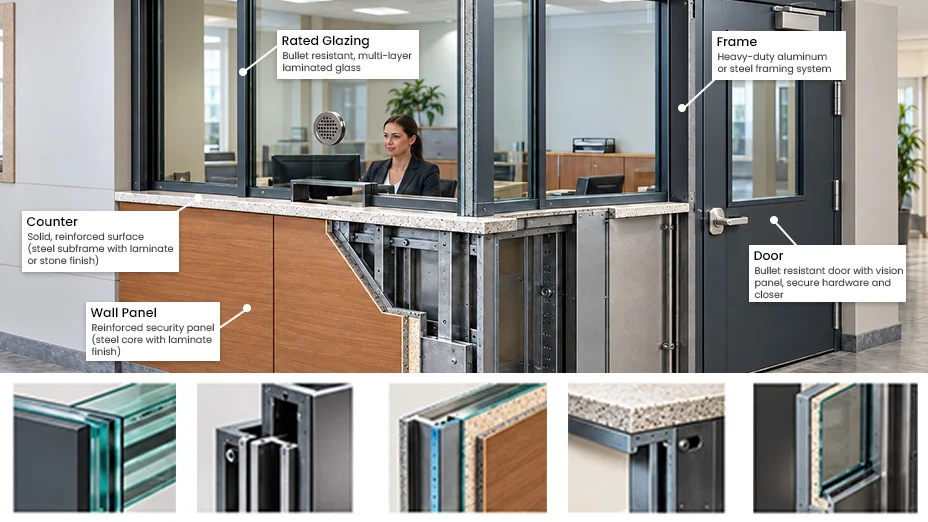
These bullet proof materials solve different construction problems. Transparent products protect sightlines and service openings. Opaque products reinforce walls, doors, counters, and protected rooms. The five families cover most bullet resistant building materials specified in commercial interiors and building shells.
| Material Family | Common Commercial Use | Main Advantage | Main Constraint | What the Submittal Must Show |
| Ballistic glass and glass-clad polycarbonate | Exterior glazing, vestibules, teller windows, secure entrances | Clear view with ratings available for handgun and rifle threats | High mass, thick edges, custom frames, longer lead time | Glazing make-up, exposed edge limits, frame listing, supported size, interior and exterior face |
| Acrylic and laminated polycarbonate | Interior transaction windows, reception screens, doors, partitions | Lower mass than glass-heavy laminates and good optical clarity | Surface scratching, solvent sensitivity, UV limits for some products | Coating, approved cleaners, maximum panel size, edge engagement, rating |
| Fiberglass composite panels | Walls, counters, desks, doors, safe rooms | Concealed behind common interior finishes and easier to cut than steel | Dust control, seam laps, edge support, and fastener details matter | Panel thickness, areal mass, overlap detail, cutout detail, fastener schedule |
| Ballistic steel | Door cores, frames, counters, equipment enclosures, compact wall zones | Thin profile for a specified rating and strong edge protection | Heavy sheets, difficult field cutting, corrosion control, ricochet risk if exposed | Alloy or product designation, plate thickness, weld and fastener detail, finish, test report |
| Reinforced concrete and fully grouted CMU | Perimeter walls, secure rooms, utility sites, new construction | Integrates security with permanent wall construction | High structural load, difficult retrofit work, uncertain results without tested details | Mix or masonry specification, reinforcement, grout, joints, penetrations, test or engineering basis |
Two bulletproof building materials of the same thickness can perform differently because their fiber direction, resin, alloy, laminate stack, backing, and support conditions differ. Compare bullet proof materials by tested threat and assembly detail before comparing thickness.
Read More : Bullet Proof Windows Cost: How Much Are Bulletproof Windows for a Storefront, Counter or Home?
What Makes Bullet Proof Materials Bullet Resistant?
A material becomes a credible part of a ballistic barrier only after a representative specimen or assembly passes a recognized test. In North American commercial construction, UL 752, Bullet-Resisting Equipment, is a common specification for glazing, doors, frames, wall panels, counters, and transaction fixtures. The test class identifies the ammunition, velocity, shot count, and shot pattern the specimen resisted. Rated bullet resistant building materials carry documents that tie those conditions to a named product or assembly.
NIJ Standard 0108.01 covers ballistic-resistant protective materials, while ASTM F3279 addresses ballistic-resistant security glazing. These standards are not interchangeable. Bulletproof building materials tested as flat sheets do not automatically transfer their rating to a frame, fastener, door, wall joint, transaction tray, or field-cut opening.
The words bullet proof materials describe what people search for. Project documents should use bullet-resistant, name the governing standard and test class, and require submittals for every barrier component. Ballistic building materials should never be approved from a marketing label alone.
Why Do Bullet Proof Materials Need Complete Rated Assemblies?
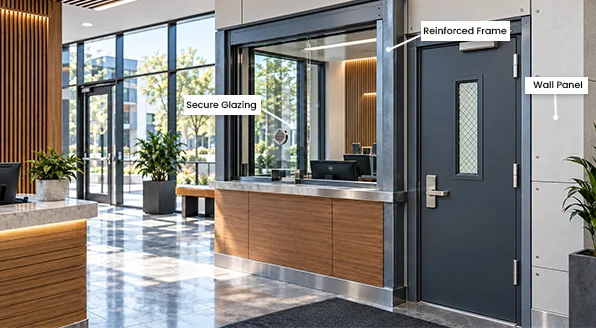
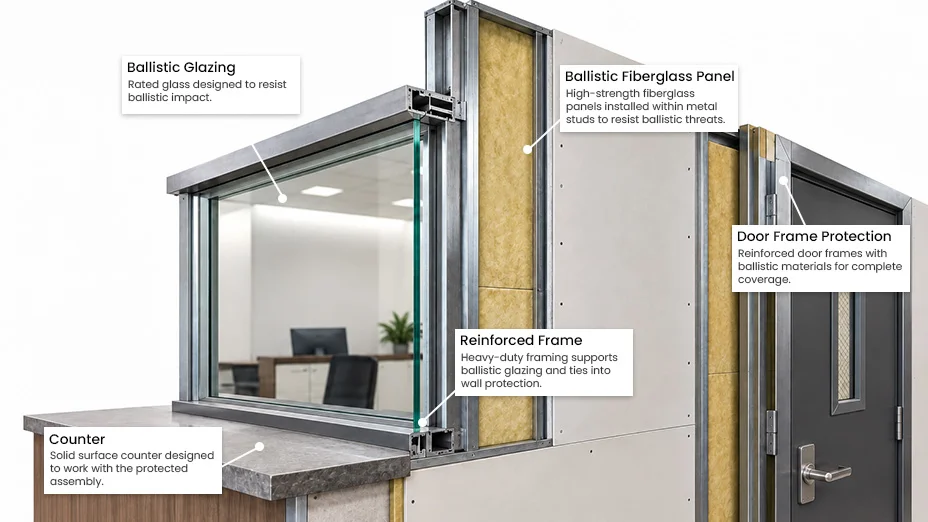
The five bullet proof materials above work only as parts of a continuous barrier. A wall panel that passes its test does not protect an adjacent unrated door, standard aluminum frame, exposed transaction opening, or uncovered return wall.
Before ordering bulletproof building materials, map the barrier in plan, section, and elevation. Then track every transition:
- Glazing to frame
- Frame to wall
- Door leaf to frame
- Hinge and lock reinforcement
- Countertop to vertical panel
- Wall to floor and deck above
- Inside and outside corners
- Electrical, mechanical, and communication penetrations
Heavy ballistic doors also change hardware demands. Compare approved commercial door hardware, commercial hinges, and door closers and accessories only after the door manufacturer states what is permitted in the listed assembly. Drilling a new hardware prep or swapping a hinge can void the tested configuration.
Egress doors must still release and swing as required. Panic exit devices used on a ballistic door need the correct fire, egress, accessibility, and assembly approvals. The commercial door hardware guide gives useful background on hinges, locks, closers, and exit devices, but the ballistic door submittal remains the controlling document.
Bullet Resistance Does Not Prove Forced-Entry, Blast, or Fire Performance
UL 752 evaluates ballistic resistance. It does not, by itself, prove resistance to a sustained tool attack, blast pressure, fire exposure, hurricane debris, or tornado debris. Projects may call for separate tests, such as ASTM F3561 or ASTM F1233 for forced-entry performance, ASTM F1642 for airblast glazing, and fire-door listings tied to NFPA 80 and the adopted building code. Each test answers a different question. Ask for documents covering every hazard named in the owner’s security criteria. In the United States, the adopted IBC, NFPA 101 where applicable, ADA Standards, and local amendments still govern items such as egress, door operation, clear width, opening force, and accessible hardware. In Canada, the National Building Code as adopted by the province or territory, local amendments, and applicable ULC or cUL listings govern those duties. A UL 752 rating does not replace either code review. The same separation applies to security hardware and entry components. Access control, locks, cameras, glazing, doors, and wall armor perform different jobs within the security plan. No list of bullet proof materials replaces a code and security review.Common Specification and Installation Errors in Bullet Proof Materials
Most failures start at an interface or a late substitution, not in the middle of untouched bullet resistant building materials. The following checks keep the specified protection continuous.Naming a Rating Without Naming the Standard
Terms such as handgun-rated or rifle-rated are incomplete. State the standard, test class, ammunition, shot count, and any forced-entry requirement in the project criteria.Buying Sheets Before Completing a Threat Assessment
Material selection should follow a documented threat assessment led by a qualified security consultant. Occupancy, likely weapons, sightlines, response time, public access, protected positions, and escape routes influence which bullet proof materials fit the project.Leaving Gaps at Seams and Corners
Butt-jointed panels can leave a direct path through the barrier. Use the tested lap, batten, backer strip, or corner construction and inspect it before finish work covers it.Cutting Unapproved Penetrations
Electrical boxes, transaction trays, intercoms, passers, ducts, and conduit can break the protective boundary. Detail them before fabrication and use rated accessories or approved backer construction.Ignoring Door Mass and Daily Operation
Ballistic glazing and armor increase door mass. The leaf, frame anchors, hinges or pivots, closer, latch, and operator must work together. Verify cycle rating, opening force, closing control, latch engagement, and accessibility after installing these bulletproof building materials.Assuming Security Film Stops Bullets
Security film can hold broken glass together and may delay forced entry when installed as part of a tested system. It is not a substitute for bullet-resistant glazing unless the entire glazed assembly carries the required ballistic test documentation.Frequently Asked Questions
Bulletproof walls are commonly built with fiberglass composite panels, ballistic steel, reinforced concrete, or fully grouted CMU. For facility teams asking what are bulletproof walls made of, the practical answer is a rated assembly rather than one generic product. People researching what are bulletproof walls made of should look past the surface finish and identify the rated layer behind it. These bullet resistant building materials may also be combined. The tested or engineered assembly must cover seams, corners, openings, supports, fasteners, and transitions into doors and glazing.
There is no strongest material for every project. Rifle threats, handgun threats, available wall depth, structural capacity, fire requirements, corrosion exposure, retrofit access, and finish needs lead to different answers. Choose bullet proof materials by a defined threat and verified assembly rating, not by thickness alone.
Bullet proof materials vary in thickness by material family and test class. Representative bulletproof materials for walls made from fiberglass span roughly 0.245 to 1.54 inches (6 to 39 mm), while architectural transparent products may range from about 3/4 to 2-1/2 inches (19 to 64 mm). Use the selected product’s current submittal, not a generic chart, for design and ordering.
No. Bulletproof glass for commercial buildings may be laminated glass, acrylic, laminated polycarbonate, glass-clad polycarbonate, or an insulated unit containing a ballistic laminate. Every specification for bulletproof glass for commercial buildings must also cover the frame, seals, edge engagement, anchors, and surrounding construction in the same rated system.
Many stud walls can be upgraded with tested fiberglass panels or steel inserts, subject to structural review and approved seam, fastener, and penetration details. These bulletproof building materials suit many retrofits. Existing masonry may also be modified, but hollow cells, utilities, joints, and foundation capacity require investigation before design.
What Should The Project Team Confirm Before Ordering?
Finish the threat assessment and mark the protected boundary on the drawings before requesting quotes for bullet proof materials. Then collect these items for each proposed product:- Test standard, class, laboratory report, and listing status
- Ammunition, velocity, shot count, spacing, and protected face
- Maximum tested panel or glazing size
- Thickness and pounds per square foot or kilograms per square meter
- Frame, anchor, fastener, seam, corner, and penetration details
- Interior or exterior exposure approval and cleaning limits
- Fire, egress, accessibility, forced-entry, and blast requirements that apply separately
- Shop drawings showing every transition in plan, section, and elevation
- Installer qualifications and inspection points before finishes close the work
- Replacement plan for impacted glazing, panels, doors, or frames