
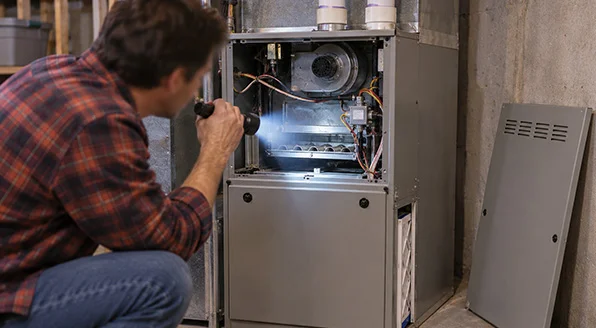
It’s the first cold night of the year. You bump up the thermostat, the furnace kicks on, the burners light, and about five seconds later the whole thing shuts off. Then it tries again. A lot of the time that’s a dirty flame sensor, the thin metal rod that tells the control board the burners actually lit. When it’s coated in gunk, the board can’t “see” the flame and cuts the gas to be safe.
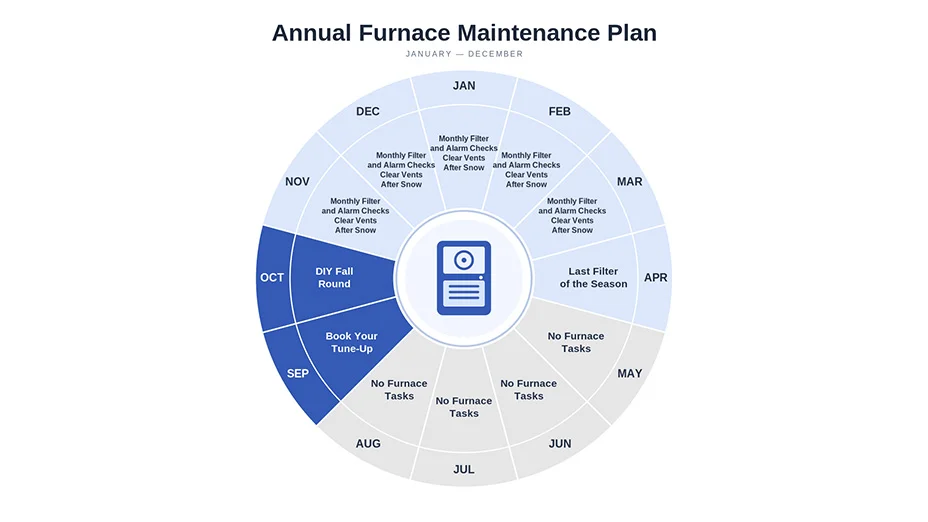
Furnace maintenance runs on two schedules. You check the filter monthly and replace it every 1 to 3 months, keep vents and the condensate drain clear, and test CO alarms. Once a year, ideally in early fall, a licensed HVAC technician inspects the heat exchanger, checks gas pressure and combustion, and cleans the burners and flame sensor.
That’s how home furnace maintenance works in real life: some jobs you can knock out on a Saturday morning, and some need a licensed HVAC technician with a combustion analyzer.
How Often Does a Furnace Need Maintenance?
A furnace needs one professional tune-up a year, plus quick checks from you every month while it’s running. That yearly visit is what people mean by annual furnace maintenance, and the best time to book it is September or early October. Furnace maintenance before winter is easier to schedule, because once the first cold snap hits, HVAC calendars fill up for weeks.
Fall furnace maintenance is also when cheap fixes get caught. An HVAC technician who spots a cracked igniter or a weak capacitor during yearly furnace maintenance swaps it on a scheduled visit, not on an after-hours call in the middle of January.
Your monthly checks take about ten minutes, and they’re the part of heating system maintenance that actually keeps a furnace alive between visits. Check more often if you have pets, just finished a drywall job, or live where the furnace runs hard from October to April, like the Upper Midwest or northern New England. Good heating system maintenance is mostly those small, regular checks. A clogged filter does more slow damage over a winter than anything else on this list.
Furnace Maintenance Checklist: What You Handle and What the HVAC Technician Handles
Print this one and tape it to the side of the furnace. Every row marked “You” is a job you can do with basic tools. Every row marked “HVAC Technician” is what you’re paying the pro for.
Task | How Often | You or an HVAC Technician | What You Need |
| Check the air filter | Monthly in heating season; replace 1-inch filters every 1 to 3 months, 4- to 5-inch media filters every 3 to 12 months | You | Filter in the exact size, marker to write the date on it |
| Clear supply registers and return grilles | Monthly | You | Vacuum with a brush attachment |
| Test CO and smoke alarms | Monthly | You | Test button; replace by the date printed on the back |
| Clear outdoor intake and exhaust pipes | After every heavy snow; check for nests in fall | You | Broom, flashlight |
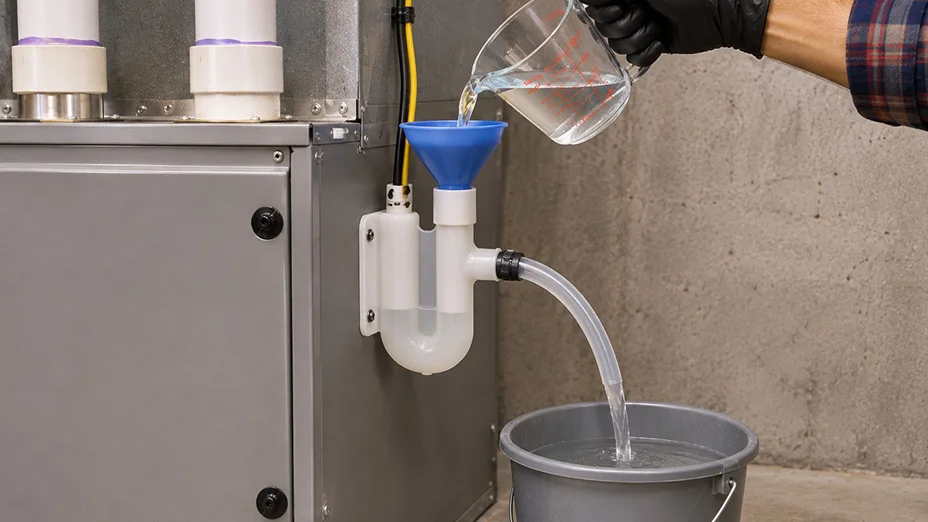
| Flush the condensate drain and trap (90%+ furnaces) | Every fall | You | Bucket, warm water, small funnel |
| Clean the flame sensor | Every fall, or when the furnace short-cycles | You | 1/4-inch nut driver, fine steel wool |
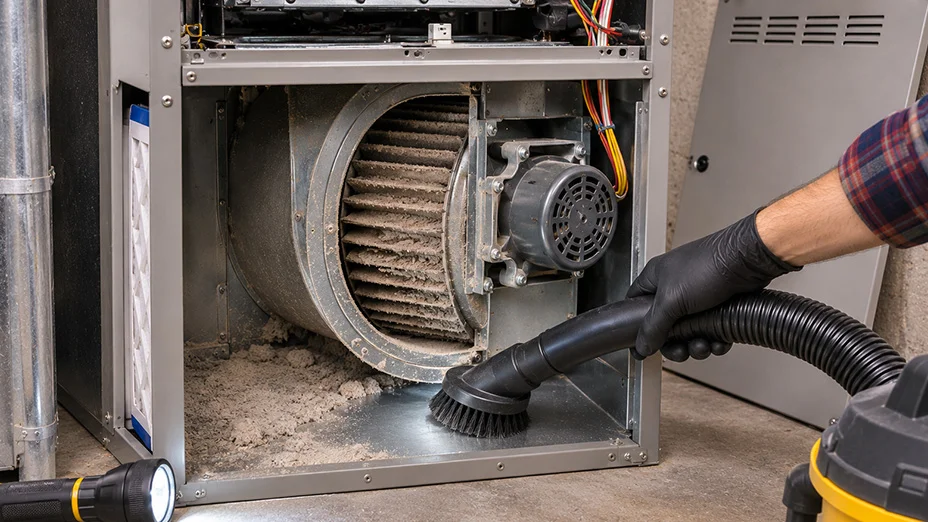
| Vacuum the blower compartment | Every fall | You | Shop vac, flashlight |
| Replace thermostat batteries | Every fall | You | Usually AA or AAA |
| Inspect the heat exchanger | Every year | HVAC Technician | Inspection mirror or camera |
| Check gas pressure and combustion | Every year | HVAC Technician | Manometer, combustion analyzer |
| Test limit and rollout safety switches | Every year | HVAC Technician | Multimeter |
| Check venting, draft and chimney liner (80% furnaces) | Every year | HVAC Technician | Draft gauge, flashlight |
This furnace service checklist covers natural gas and propane forced-air furnaces. Oil furnaces need a different furnace maintenance checklist.
DIY Furnace Maintenance: Five Jobs You Can Do Yourself
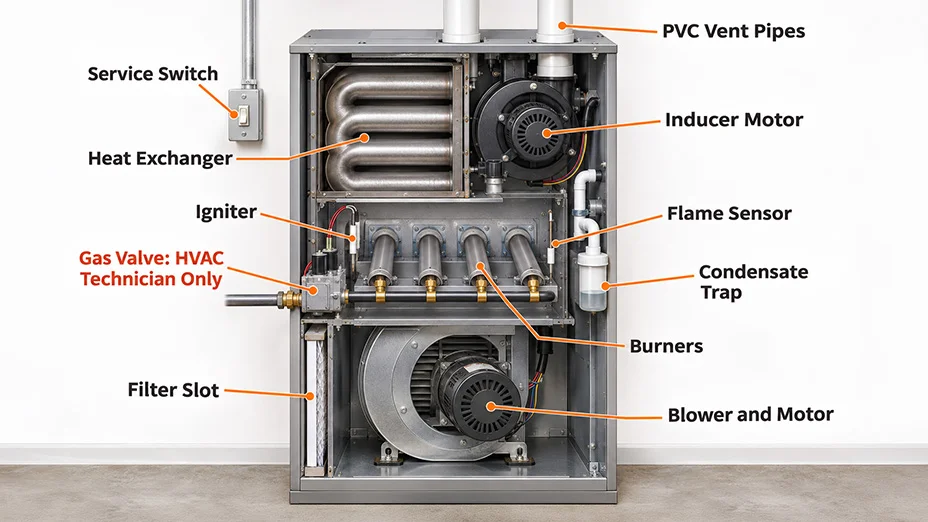
DIY furnace maintenance comes down to five jobs. They count as safe gas furnace maintenance because none of them involve the gas line or the gas valve. Before you start, kill power at the furnace service switch (it looks like a regular light switch on or near the unit) and give the burners and inducer a few minutes to cool.
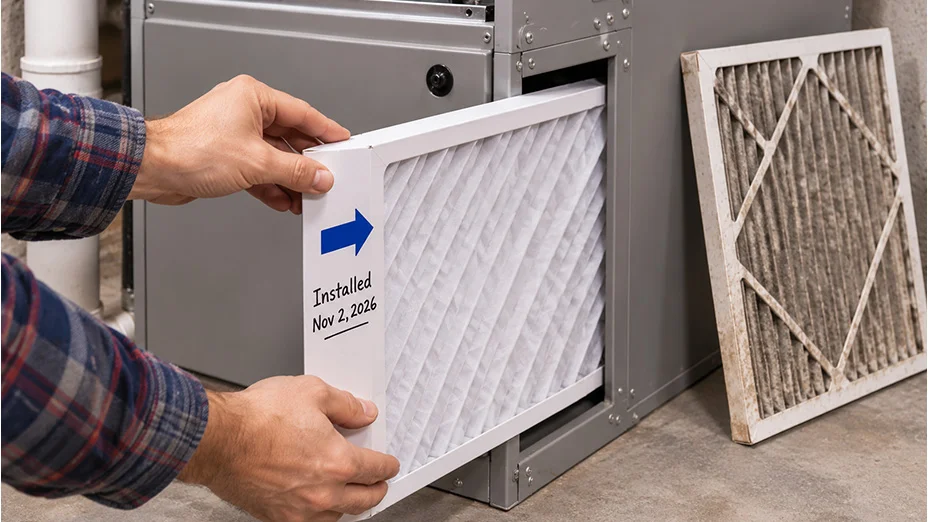
Replace the filter
Pull the old one and read the size off the frame. The printed size is the nominal size, so a “16x25x1” filter actually measures a hair smaller. Slide the new one in with the airflow arrow pointing toward the blower, meaning into the furnace and away from the return duct. If you’re not sure which MERV rating your system can handle, our furnace air filter guide walks through it, and you can pick up replacement air filters in standard sizes. Write the install date on the frame with a marker.
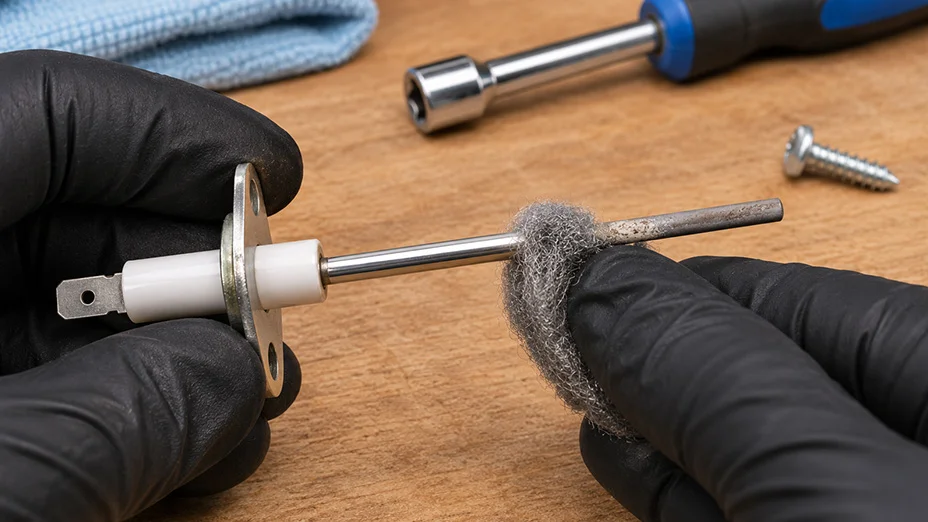
Clean the flame sensor
Find the thin rod sitting in the burner flame, usually held by one 1/4-inch hex screw. Take a photo first, pull it out, and rub the metal rod lightly with fine steel wool until it’s shiny, wiping along the rod, not around it. Skip the sandpaper. At least one major furnace maker’s manual warns that the silicone in sandpaper contaminates the rod and makes the problem worse. Don’t touch the white porcelain, and don’t bend the rod.
Flush the condensate drain and trap
This only applies to high-efficiency furnaces (90% AFUE and up), the ones with white PVC pipes. Find the clear or white trap on the side of the cabinet, disconnect the drain hose, and pour warm water through it with a funnel until it runs clear. If you see slimy buildup, a cup of white vinegar usually breaks it up. A clogged trap is one of the most common reasons a high-efficiency furnace throws a pressure switch code and won’t light.
Clear the outdoor vent pipes
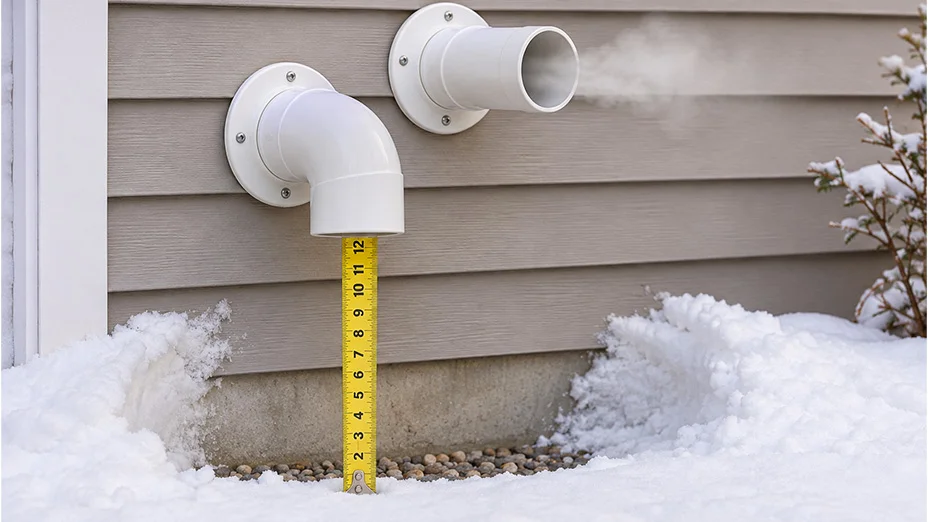
Walk outside and look at the two PVC pipes. Most installation manuals want both of them at least 12 inches above the ground or the highest expected snow level. Brush off snow and frost after every storm, and look for bird or wasp nests in early fall.
Vacuum the blower compartment and listen to the motor
With the power still off, vacuum dust off the blower housing, the floor of the cabinet and the visible blower wheel blades. This is the part of furnace blower motor maintenance you can handle yourself. Older motors with little oil ports need a few drops of non-detergent motor oil; most newer ones are sealed and need none. Once the power’s back on, listen for a hum with no spin or a slow start. That usually points to a weak run capacitor, which an HVAC technician should confirm with a meter before you order motor capacitors.
What not to touch: the gas valve, the gas line, the limit switches, and the heat exchanger panels. Furnace preventative maintenance never means jumping out a safety switch to “test” it.
What an HVAC Technician Checks During Annual Furnace Maintenance
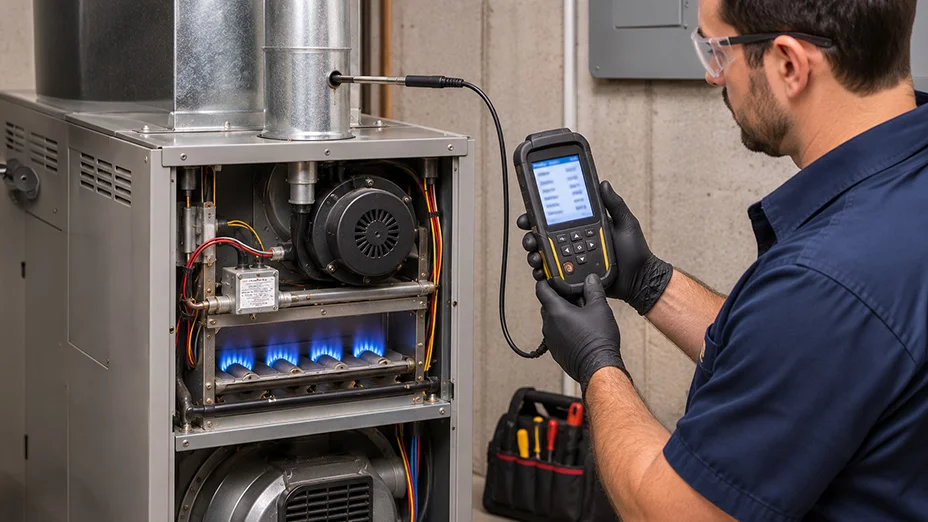
The pro half of annual furnace maintenance is about safety readings you can’t take yourself. The HVAC technician should open the burner compartment and check:
- Heat exchanger: cracks or rust-through, using a mirror or camera. A cracked heat exchanger can let carbon monoxide into your supply air.
- Combustion: CO in the flue gas, measured with a combustion analyzer.
- Gas pressure: manifold pressure checked against the furnace’s rating plate. That’s usually around 3.5 inches of water column on natural gas and around 10 inches on propane.
- Temperature rise: the difference between return air and supply air, checked against the range printed on the rating plate.
- Safety switches: high limit, rollout and pressure switches tested so they actually shut the furnace down when they should.
- Ignition and flame signal: the igniter’s condition and the flame sensor’s signal in microamps.
- Burners and venting: burners cleaned, flame pattern checked, vent connections and draft inspected.
Here’s how to tell a real visit from a drive-by: ask for the numbers. An HVAC technician who did the work can read you the CO level, the gas pressure and the temperature rise off their sheet. If all you get is “everything looks good,” you paid for a visual inspection.
Gas Furnace Maintenance for Natural Gas, Propane and High Efficiency Units
Gas furnace maintenance follows the same basic checklist on every forced-air unit. What changes is the fuel and the efficiency rating, and those two things decide which parts you need to watch most. For natural gas furnace maintenance, the checklist above covers you. Propane and high-efficiency furnaces add a few extra items.Propane Furnace Maintenance
Propane runs at a higher manifold pressure than natural gas and uses smaller burner orifices, so a furnace has to be set up with a conversion kit for the fuel it burns. Propane is also heavier than air, so a leak sinks and collects in basements and crawlspaces instead of drifting up. Part of propane furnace maintenance happens outside: have your propane supplier check the tank regulator when they fill you up in fall. Never run a natural gas furnace on propane, or the other way around, without the kit and a licensed HVAC technician.High Efficiency Furnace Maintenance
A furnace rated 90% AFUE or higher squeezes so much heat out of the exhaust that water condenses inside it. That’s why it has a second heat exchanger, a condensate trap, and PVC vent pipes instead of metal. Most of the extra work is about water: keep the trap clean, and watch any drain line or condensate pump that runs through an unheated garage or attic, where it can freeze and shut the furnace down on the coldest night of the year.| Furnace Type | How It Vents | What Usually Fails | Extra Item to Watch |
| Standard (80% AFUE) | Metal vent into a chimney or B-vent | Draft problems, rusted vent connector | Chimney liner and draft |
| High efficiency (90%+ AFUE) | PVC pipes through a wall or roof | Clogged trap, blocked vent, frozen drain line | Condensate trap and outdoor pipes |
| Propane (either type) | Same as its efficiency class | Regulator issues, orifice mismatch after a fuel change | Tank regulator and conversion kit |
Warning Signs That Can’t Wait for the Annual Visit
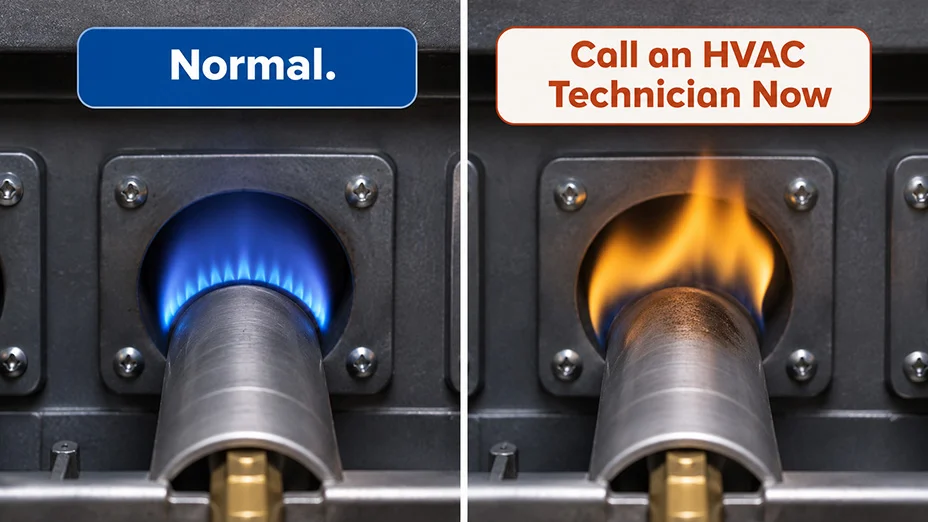
Some furnace problems mean you call today, not next fall. Watch for these:- Yellow, orange or lazy flames, or flames lifting off the burners, instead of a steady blue
- Soot around the burner opening or on the wall near the vent
- A CO alarm going off, or headaches and nausea that ease up when you leave the house
- A rotten-egg smell near the furnace or gas line
- The furnace locking out over and over with a flashing error code
- Scorch marks or melted wire insulation near the burner area
- Water pooling under a high-efficiency furnace
Cost of Furnace Maintenance: What US Homeowners Pay
The cost of furnace maintenance for a standard tune-up runs about $70 to $200 for most US homes. Here’s how the common visits break down.| Service | Typical Range | What’s Usually Included |
| Inspection only | $70 to $130 | Diagnostic check and report, light cleaning at most |
| Standard tune-up | $70 to $200 | Inspection, cleaning, safety checks, adjustments |
| Furnace cleaning | $70 to $300 | Burner, blower and cabinet cleaning |
| Yearly plan or tune-up plus minor repairs | $150 to $500 | Tune-up, priority booking, small parts or discounts |
What to Do Next?
- Tape up the furnace maintenance checklist from earlier in this guide where you’ll see it every time you change the filter.
- Grab your numbers. Write down the filter size, the furnace model and serial number from the rating plate, and the install date. Snap a photo so you have it at the store.
- Book the fall visit now. If you’re reading this in October or November, call this week. Ask what the visit includes so you can compare the cost of furnace maintenance between two or three companies on the same work.
- Buy a winter’s worth of filters. Depending on how often you change them, three to six 1-inch filters cover a typical heating season, while one 4- or 5-inch media filter can last most of a year.
- Check your CO alarms. Look at the replace-by date on the back and make sure you have one outside each sleeping area.
- Call a pro instead if you see any of the warning signs above, if your local rules or your warranty call for licensed work, or if the flame sensor fix doesn’t stop the short-cycling.
Furnace Maintenance FAQs
A thorough pro tune-up usually takes about an hour, sometimes longer on an older or dirty unit. If the HVAC technician is in and out in 20 minutes, the combustion and gas pressure checks probably didn’t happen. Your own fall round of DIY jobs takes 45 minutes to an hour the first time and about half that once you know your furnace.
Only for as long as it takes to run to the store, and it’s better to leave the old filter in until then. Without a filter, dust coats the blower wheel and the AC coil that sits on top of most furnaces. Then the system moves less air and runs hotter, and a dirty coil can cost a lot more to clean than a filter costs.
Usually the landlord. Keeping the heat working is part of a landlord’s basic duty to keep a unit livable in most states, so heating system maintenance and the yearly tune-up land on them. Many leases hand filter changes to the tenant, so check yours. Several states, including California, Illinois and Utah, also require landlords to put CO alarms in rentals that have fuel-burning appliances.
For some brands, yes. A few manufacturers’ warranties say you may need to show invoices for yearly service, and missing proof can get a claim denied. Even when the warranty doesn’t spell out a yearly visit, it almost always excludes damage caused by poor maintenance. Keep every receipt in a folder near the unit or snap a photo of it.