



What Does Winterizing a Boat Mean?
Winterizing a boat means putting every water-holding part of it into a state where freezing cannot split it, and every fuel-holding part into a state where ethanol gasoline cannot gum it. The engine cooling passages, the freshwater tank and lines, the head (the marine toilet and its hoses), the livewell plumbing, the bilge and the batteries each get their own step. Boat winterization is five systems, not one job: engine, fuel, water, electrical, and hull and cover. Skip one and the other four do not save you. That is the practical answer to what does winterizing a boat mean, and it is why winterizing a boat takes an afternoon rather than an hour. A perfectly fogged outboard on a boat with a full freshwater tank still comes back in April with a split tank seam.When Should I Winterize My Boat?
Do it before the first night that drops below 32°F (0°C) for more than a few hours, not after. Water inside a block, manifold or hose has no way to drain once it has turned to ice, so the deadline is the first frost forecast, not the calendar.| Region | Typical First Hard Freeze | Practical Deadline |
| Northern Minnesota, northern Wisconsin, Upper Michigan | Mid to late September (Duluth averages October 1; International Falls September 15) | Mid September |
| Twin Cities, southern Wisconsin, lower Michigan | Early to mid October | First week of October |
| Great Lakes shoreline (Ohio, New York, Ontario) | Late October to early November | Mid October |
| Mid-Atlantic and Ohio Valley | Early to mid November | Late October |
| Prairies (Manitoba, Saskatchewan, Alberta) | Late September | Mid September |
| BC coast and Pacific Northwest | Mid November to December | Early November, and watch the forecast |
| Gulf Coast, Florida, Southern California | Rare or none | Fuel and moisture steps only, done whenever the boat sits 30+ days |
How Do You Winterize a Boat Engine by Type?
The engine is where freeze damage costs the most, and how to winterize a boat engine changes with the drive type. Outboards drain themselves; sterndrives and inboards do not. The steps to winterize boat engines below cover both.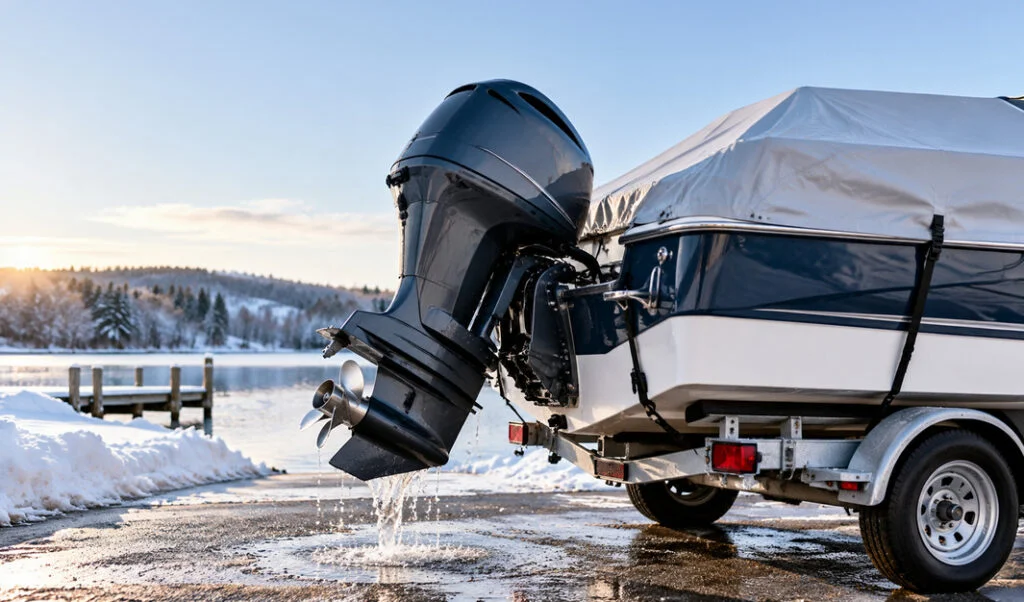
An outboard stored fully tilted down (vertical) drains its own cooling passages through the lower unit. Trapped water is what does the damage: an outboard left tilted up on the trailer holds water up in the powerhead, and that water cracks the powerhead when it freezes.
- Flush with fresh water for 10 to 15 minutes using flush muffs (the earmuff-style clamp that seals a garden hose over the water intakes) or the built-in flush port. Run at idle only; muffs cannot supply enough water above idle.
- Add fuel stabilizer to the tank at the ratio on the bottle, then run the engine on the treated fuel for at least 10 minutes so stabilized fuel reaches the carburetor bowls or injectors and the vapor separator tank. Pick a stabilizer and filter from the marine fuel system supplies rated for ethanol blends.
- Fog the engine. Carbureted motors: spray fogging oil into the air intake at fast idle until the exhaust smokes heavily, then shut down. EFI and four-stroke motors: pull the plugs, spray fogging oil into each cylinder for 3 to 5 seconds, crank for 2 to 3 seconds with the kill lanyard pulled, reinstall the plugs. Mercury’s published procedure for four-strokes and carbureted two-strokes is spray-in-the-cylinder with its Storage Seal fogging oil; for OptiMax direct-injection two-strokes it is 1 oz (30 ml) of DFI two-stroke oil in each cylinder through the plug hole instead of fogging spray. Yamaha’s published procedure matches: intake fogging on carbureted models, cylinder fogging with the plugs out on EFI models. Yamaha also has a stabilizer heavier for layups over 60 to 90 days, 1 oz per gallon (30 ml per 3.8 L) instead of 1 oz per 3 gallons. Confirm against the manual for your model year.
- Drain the lower unit gear lube through the lower drain screw with the upper vent screw removed. Milky lube means water got past a prop-shaft seal; replace the seal before storage, not after, because that water freezes inside the gearcase. Refill with the gear lube the manual specifies (Mercury calls for its SAE 90 High Performance Gear Lube; Yamaha its own gearcase lube) until it runs out the upper vent, then put the top vent screw in first and the bottom screw right after, so the fresh lube cannot drain back out.
- Change the four-stroke engine oil and filter while the engine is warm. Used oil holds combustion acids that etch bearings over a long storage.
- Pull the prop, clean the fishing line off the shaft, grease the splines with marine grease, and reinstall with the correct torque from the manual. Grease every zerk fitting on the tilt tube and steering.
- The store tilted fully down. If the trailer skeg clearance forces some tilt, use the trailer tongue jack to raise the bow until the motor is as close to vertical as possible.
That is how to winterize a boat with an outboard in most cases: nothing in the motor needs antifreeze if it is stored vertically and drained. If you cannot store it vertically, run the flush with -50°F (-46°C) propylene-glycol antifreeze through the muffs until the telltale (the small stream that shows cooling water is moving) runs pink.
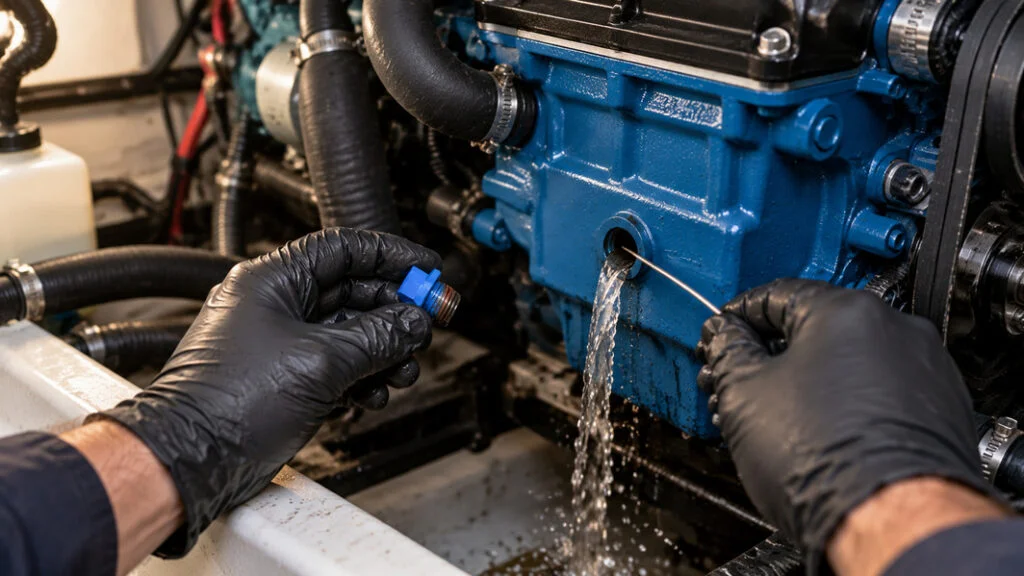
- Run the engine to operating temperature on stabilized fuel (see the outboard step). Warm water drains faster and carries sediment out with it.
- Change the oil and filter, then the drive gear lube (sterndrives) or transmission fluid (inboards) per the manual.
- Drain the block and manifolds. Locate the drain points: MerCruiser small-block V6 and V8 engines use blue plastic drain plugs on each side of the block and on each manifold; older engines use brass petcocks. Some later MerCruisers replace the individual plugs with a single-point or air-actuated drain system that empties the block and manifolds from one point; the owner’s manual for your serial range says which you have. Open every drain, then push a length of 12 AWG solid copper wire or a small screwdriver into each hole to break up rust and scale that blocks the flow. Trapped scale is the most common cause of a cracked block on an engine the owner “drained”.
- Drain the raw-water pump, the oil cooler and the power-steering cooler if the engine has them. Pull the raw-water pump hose off at its lowest point.
- Fill with antifreeze after draining. Close the drains, then feed -50°F (-46°C) propylene-glycol antifreeze through the raw-water pickup using a winterizing kit (a 5-gallon bucket with a hose to the intake) or through the flush muffs while the engine idles, until pink discharge runs from the exhaust. Draining alone works; antifreeze after draining adds corrosion protection and covers any low spot you missed.
- Fog the cylinders through the carburetor or through the plug holes as above. Mercury’s MerCruiser MPI procedure instead runs a fogging mix from a portable tank: 5 gallons (19 L) of gas with 2 quarts (1.9 L) of Mercury Premium Plus two-stroke oil and 1 oz (30 ml) of Quickstor stabilizer. Closed-cooling (freshwater-cooled) engines still need the raw-water side drained; check the coolant side with a hydrometer or refractometer for protection to -34°F (-37°C) with a 50/50 ethylene-glycol engine coolant.
- Check the bellows — the rubber accordion boot between the transom and the drive — for cracks with the drive tilted up and a flashlight, then store the drive tilted fully down so water leaves the drive and the boot rests without a fold.
How Much Antifreeze to Winterize Boat Systems?
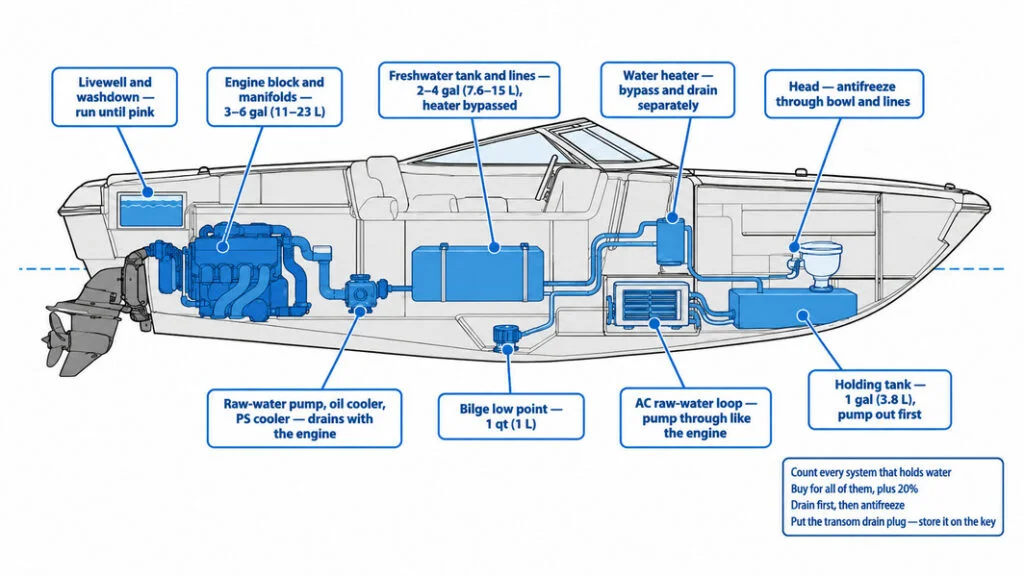
Plan on 2 gallons (7.6 L) per outboard flush, 3 to 6 gallons (11 to 23 L) per sterndrive or inboard engine (MerCruiser parts guides quote 3 to 4 gallons for a single small-block), 2 to 4 gallons (7.6 to 15 L) for a freshwater system with a 20 to 40 gallon tank and water heater bypassed, and 1 gallon (3.8 L) per head. Buy 20% more than that estimate; running short mid-job is the mistake that leaves a line unprotected. The right antifreeze for winterizing boat plumbing, engines and raw-water cooling — and the first thing anyone learning how to winterize a boat should buy — is propylene glycol sold as RV and marine antifreeze, usually pink, rated -50°F (-46°C) or -100°F (-73°C). A -50°F RV and marine antifreeze is the standard choice across the northern US and southern Canada. Use the -100°F grade in the Prairies, northern Ontario and Quebec, and Alaska, or wherever the storage yard sees -30°F (-34°C) nights. Two rules people get wrong:- Never dilute it. The -50°F rating is a burst-protection rating for undiluted product; the same product starts forming ice crystals at about +20°F (-7°C), and the -100°F grade at about -20°F (-29°C). Slush in a stored line is harmless; the point is how little margin is left once water thins the mix. Every gallon of water left in a line or tank thins the mix, which is why you drain first and then add antifreeze.
- Never use automotive ethylene glycol (green) in a raw-water, freshwater or head system. It is toxic to people and to the lake you launch next spring. Neither type may be discharged to surface water, storm drains or septic systems without authorization under state clean-marina rules (Connecticut DEEP’s antifreeze guidance is typical), so when you flush the system in spring, catch the pink discharge in a bucket and take it to a marina or municipal collection point.
Winterize Boat Plumbing, Livewells and the Head
Most guides on how to winterize a boat stop at the engine; the plumbing is where the second-most-expensive damage happens. Every fresh and raw water circuit on the boat gets drained and then pumped with antifreeze until it runs pink at every faucet and drain. Skip one hidden 3/8 in (10 mm) supply hose behind a bulkhead and the water trapped inside freezes and splits that hose — the same failure as an undrained block, found in spring when the pump floods the cabin.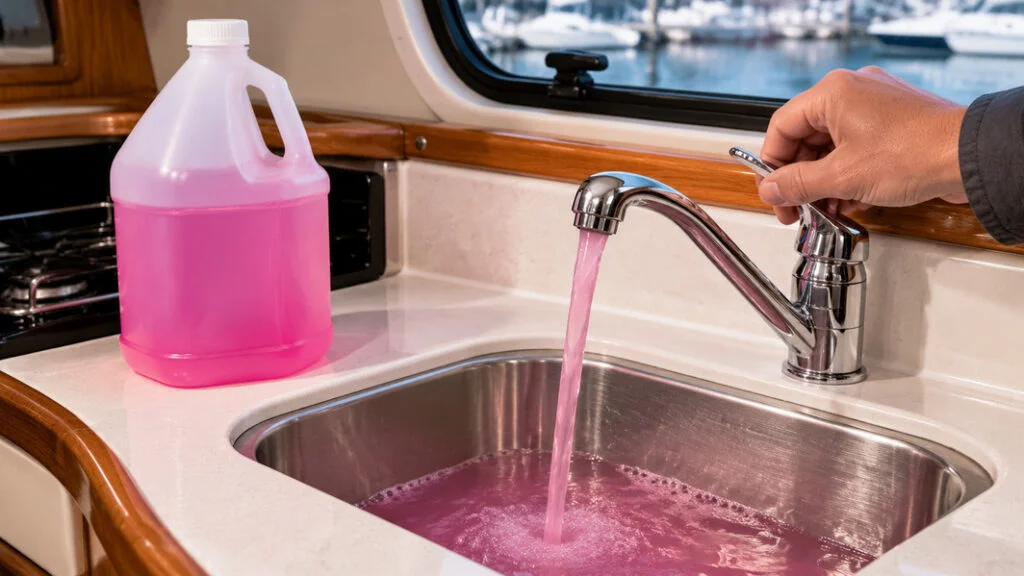
- Freshwater: drain the tank at its drain valve, bypass the water heater (a bypass kit with three valves lets you skip filling a 6 gallon heater with antifreeze; drain the heater separately), then connect the pump inlet to a jug of antifreeze and open each faucet, hot and cold, shower and transom shower, until pink flows.
- Head: pump out the holding tank, flush fresh water through it, then draw antifreeze through the intake seacock or a bucket at the intake hose until pink shows in the bowl and at the discharge fitting. Close the seacock. A macerator pump (the grinder pump that empties the holding tank) gets a run with antifreeze too.
- Livewells and washdowns: run the pumps until they discharge pink, then leave the drains open. Ball-valve seacocks get closed; check each one turns freely and grease the ball. Replace any seacock, hose or through-hull fitting that is cracked or corroded now, while the boat is dry and up on stands where you can reach everything.
- Bilge: pump and sponge it dry, then pour a quart (1 L) of antifreeze into the lowest point so any water that finds its way in cannot freeze around the float switch.
- Air conditioning: pump antifreeze through the raw-water side of the AC unit the same way as the engine.
Fuel: Fill, Stabilize, Filter
Fill the tank to about 90 to 95%, add stabilizer, and change the fuel filter and water separator. This is the one part of how to winterize a boat that applies in Miami as much as Duluth. A near-full tank leaves less air to condense moisture on cold nights; the headspace allows the fuel to expand on warm days without venting out the fill. Ethanol (E10) fuel absorbs water until it phase-separates into a water-ethanol layer at the bottom of the tank, which is what the fuel pickup draws first in spring. Stabilizer slows the oxidation that forms varnish; it does not fix fuel that has already separated. Untreated gasoline starts forming varnish in as little as 30 days, and E10 that has sat for 90 days is already degrading. Use a marine-formula stabilizer dosed for the tank capacity, not a splash from a bottle, and run the engine long enough to pull treated fuel through the whole system. Diesel boats get a biocide and a diesel stabilizer instead, and a full tank, because microbial growth at the fuel-water interface is the winter problem, not varnish.Batteries and Electrical
To winterize boat batteries, pull them, or at minimum disconnect the negative cables, and store them fully charged above freezing on a maintainer. A fully charged lead-acid battery will not freeze until somewhere around -75°F to -90°F (-60°C to -68°C), depending on the chart you read; a discharged one freezes close to 32°F (0°C) because its electrolyte is nearly water, and splits its case. Self-discharge plus a bilge pump float switch that cycles a few times is enough to get a battery to that state by February.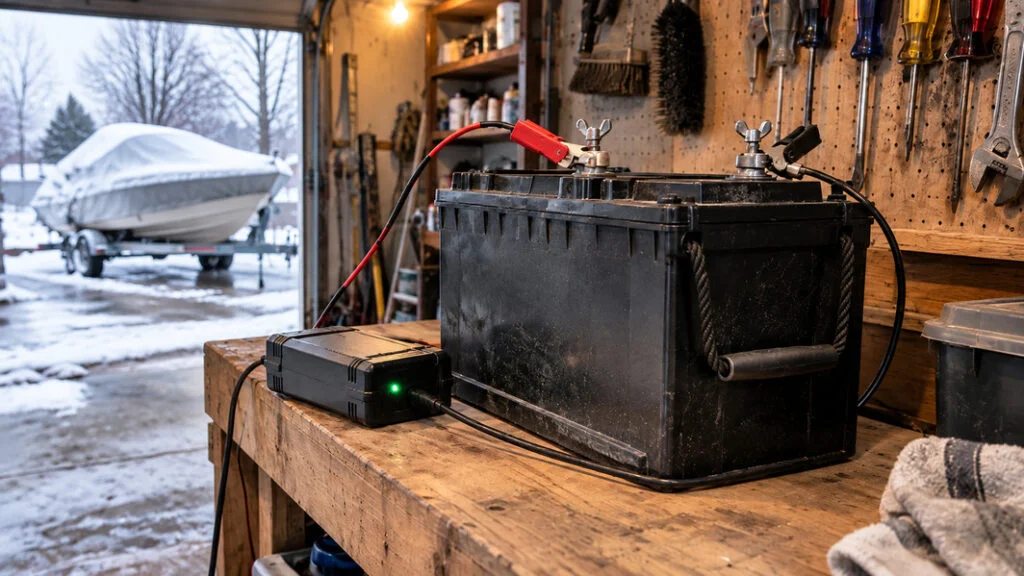
Hull, Interior and Moisture
Owners who learn how to winterize a boat from the engine manual alone skip the hull. Wash and wax it before storage, not after, because dirt and waterline scum bond harder over a winter. Fiberglass gets a coat of paste wax on the topsides. Aluminum hulls get an inspection at every rivet line and weld for slow seeps (they show as streaks or stains); mark each one with tape for a spring repair with a marine sealant rated for below-waterline use. Bottom paint stays on; scrub it, note any blisters, and let it dry. Inside, pull every cushion, PFD, line and canvas item and store it indoors dry. Wipe vinyl with a mildew stain remover and vinyl cleaner, open every locker and hatch, and set a 4 lb moisture absorber in the cabin and one in the bilge. Target under 50% relative humidity under the cover; mildew starts above 60%. Rodents get in through the exhaust, the intake and any gap in the cover. Stuff stainless steel wool (not carbon steel, which rusts and stains) into the exhaust outlets and air intakes, tag each one with a bright ribbon so you remember to pull it in spring, and remove every scrap of food and paper. Mercury recommends dryer sheets and mothballs in every compartment as a deterrent; pest-control companies rate the dryer sheets as weak on their own. Sealed entry points are what works, with deterrents as a backup.Cover and Storage Choices
The last decision on how to winterize a boat is where it sits and what covers it. The cover’s job is to shed water and snow, not to seal the boat. Any cover that traps moisture without vents grows mildew and traps condensation against the gelcoat.| Storage Option | Protection | Cost Level | Where It Makes Sense |
| Indoor heated | Full; no freeze risk if temperature holds | Highest | Northern climates, large boats, boats with complex systems |
| Indoor unheated (barn, pole building) | Snow, sun and rodents; freeze risk stays, so full winterization required | Moderate | Most trailer boats in the North |
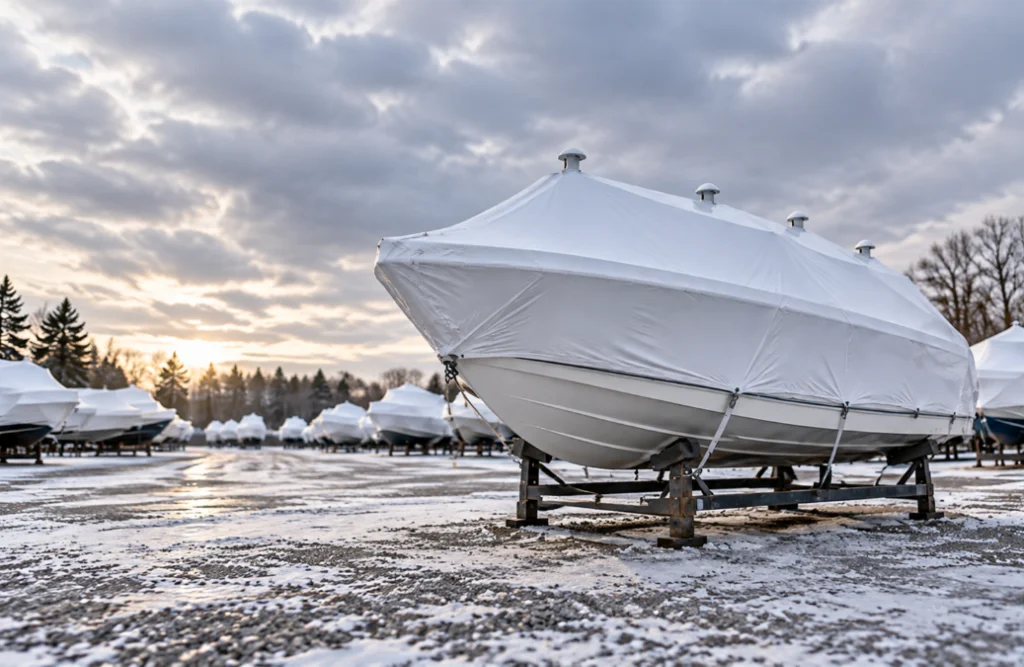
| Outdoor with shrink wrap (7 mil, at least 4 vents on a runabout, 8 or more over 34 ft / 10 m) | Snow and UV; vents control moisture | Moderate per season, non-reusable | Boats too big to trailer home, marina yards |
| Outdoor with fitted cover on a frame (pitch 20° or more) | Snow if framed, UV | Lower over 3+ seasons | Trailer boats with a ridge pole or bow support |
| Outdoor with a plain tarp | Poor; ponds water, chafes gelcoat, blows off | Lowest | Short-term only, southern climates |
| In the water (bubbler or de-icer) | No haul-out; freeze risk for through-hulls and engine unless heated and monitored | Marina fees | Ice-free harbors and boats with cabin heat, checked weekly |
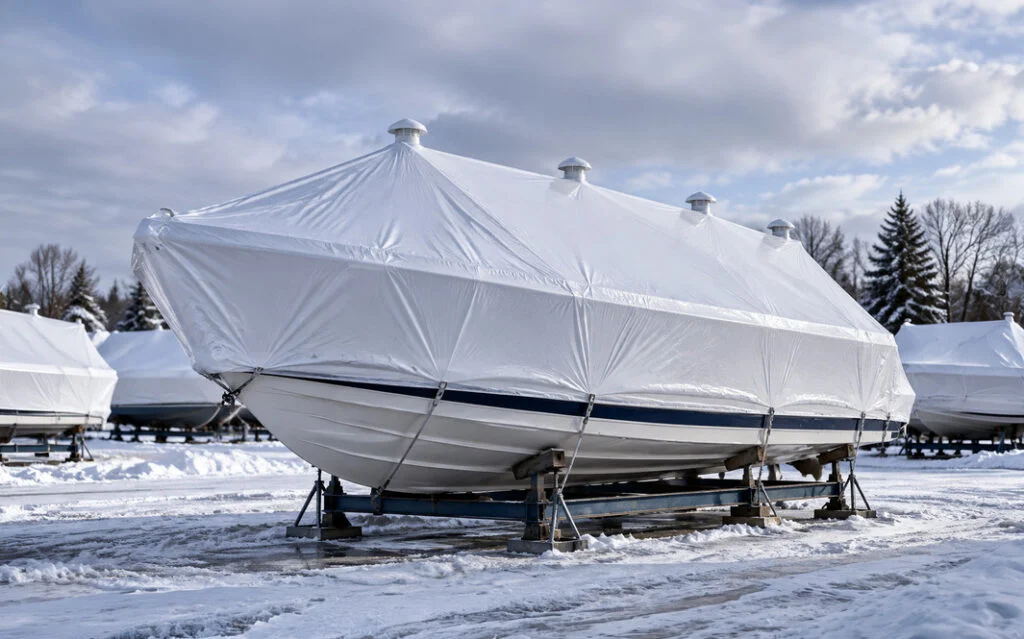
How to Winterize Your Boat in Florida vs. Minnesota
The steps for how to winterize a boat are identical in both states; the reason you do them is not. In Minnesota you are fighting ice; in Florida you are fighting fuel, humidity and rodents through a 30 to 90 day layup. In Florida the job is fuel stabilizer, a fresh fuel filter, a full oil change, fogging, a battery maintainer, and moisture absorbers under a vented cover — everything people search as how to winterize your boat in Florida comes down to fuel and mildew, not ice. Add antifreeze to the freshwater and head systems only if the boat sits through a January cold snap in the Panhandle or North Florida, and skip antifreeze in the engine. The freeze risk is a few nights below 32°F (0°C) north of Orlando; south of there, mildew and phase-separated fuel are the whole risk. Gulf-coast boats also get a corrosion-inhibitor wipe on every bare metal fitting, because salt air keeps working while the boat sits. Minnesota gets everything in this article, done by mid September north of Brainerd and before October 10 in the Twin Cities — the deadline is the real answer to how to winterize your boat in Minnesota. Use -50°F antifreeze at minimum, and -100°F if the boat stores outside in the northern half of the state. Plan a mid-winter check on the cover after the first heavy snow and again after the January thaw. Canada mirrors the Minnesota approach across most of the country. Transport Canada does not regulate winterization, but provincial environment rules on antifreeze discharge apply and marinas enforce their own checklists. Use metric-rated antifreeze labels: -46°C is the -50°F product, -73°C is the -100°F product.Cost to Winterize a Boat and How Long It Takes
Doing it yourself versus paying a yard comes down to supplies against labor. Doing it yourself costs the price of supplies (antifreeze, stabilizer, oil, filter, gear lube, fogging oil, moisture absorbers) and 3 to 6 hours. Paying a yard costs several times that for an outboard boat and more again for a sterndrive with a freshwater system, plus shrink wrap billed per foot of boat length. How long does it take to winterize a boat? An outboard runabout with no plumbing: about 3 hours the first time, 2 once you know the drain points. A sterndrive cuddy with freshwater, head and livewell: 5 to 6 hours. A twin-inboard cruiser: a full day, and a yard job unless you have done it before. Ask your yard how long does it take to winterize a boat in October, and the honest answer is a two-week wait before they even start — one more reason to book early or do it yourself. The cost to winterize a boat is small next to what it prevents. A freeze-cracked block on a MerCruiser 4.3 or 5.0 is not a repair; it is a long block replacement, an engine-out job at any yard.What Happens If You Don’t Winterize Your Boat
Water freezes and splits whatever holds it, fuel turns to varnish and water, and moisture and rodents get to work on everything else. The damage shows up in spring, in this order of cost:- Cracked engine block, manifolds or risers on sterndrives and inboards from water left in the cooling passages.
- Cracked powerhead or gearcase on outboards stored tilted up with trapped water.
- Split freshwater tank seams, water heater tank and PEX or vinyl lines.
- Cracked head bowl, pump housing and holding tank fittings.
- Gummed carburetor jets and clogged injectors from untreated ethanol fuel.
- Battery cases split by freezing after discharge.
- Cylinder-wall and bearing surface rust from unfogged cylinders and acidic oil.
- Mildewed upholstery, fogged electronics, chewed wiring.
Winterizing a Boat Checklist
Run this winterizing a boat checklist in order and initial each line; the drain-plug and antifreeze steps are the ones people skip when working from memory.- Fuel to 90%, stabilizer added, engine runs 10 to 15 minutes on treated fuel.
- Engine oil and filter changed warmth; gear lube or transmission fluid changed.
- Raw-water side drains at every drain point, holes cleared with wire, then antifreeze runs through until pink discharge.
- Cylinders fogged; plugs reinstalled.
- Outboard or sterndrive stored tilted fully down.
- Freshwater tank drained, heater bypassed, antifreeze at every tap.
- Head and holding tank pumped out and filled with antifreeze; seacocks closed.
- Livewells, washdowns, AC and bilge pumped with antifreeze; drains left open.
- Transom drain plug removed and stored on the key; boat set bow-high.
- Batteries disconnected, charged, on a maintainer above freezing.
- Hull washed and waxed; interior emptied, cleaned, moisture absorbers placed.
- Exhaust and intakes plugged with stainless wool and tagged.
- Cover fitted with vents, framed for snow, padded at contact points.
- Trailer tires up to pressure or off the ground, bearings greased, tongue jack on a block.
Frequently Asked Questions
Yes, the fuel, oil, battery and moisture steps apply anywhere the boat sits 30 days or more. If you are asking do I need to winterize my boat in a place like South Florida or the California coast, the answer is a partial winterization: skip the engine antifreeze, do everything else.
The engine, plumbing and head get the same drain-and-antifreeze treatment as a hauled boat, plus closed seacocks, doubled lines with chafe protection, a de-icer if the harbor ices, and a weekly check. How do you winterize a boat you cannot reach weekly? You haul it; in-water storage without a visit schedule is the highest-risk option on the list.
Stabilize fuel and run, flush, change oil and gear lube, fog, pull the drain plug, disconnect the battery, store the motor vertically, cover with vents. That is the full set of steps to winterize a boat of that type, about 2 to 3 hours of work.
For an outboard stored vertical, yes, and that is how to winterize a boat with no plumbing in most of the South. For a sterndrive or inboard, only if you drain every point and clear every hole, and most owners miss at least one; antifreeze after draining is cheap insurance. A freshwater or head system, no; there is no way to blow every low spot dry without a compressor and fittings, and even then antifreeze is the standard.